SANCTUARY OF OUR LADY BIEN APARECIDA
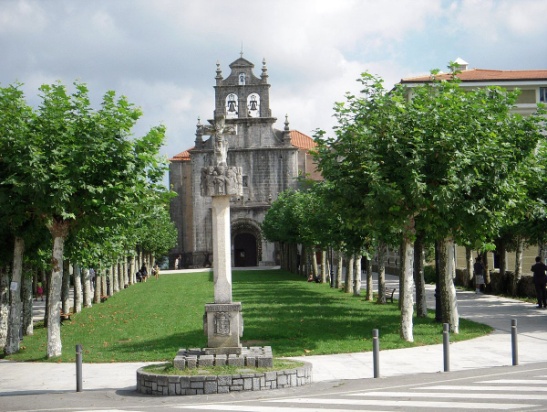
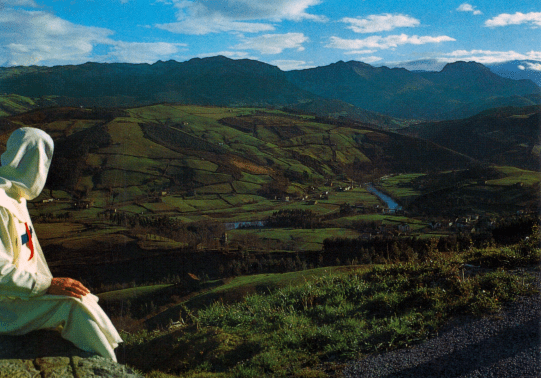
On the green slopes of the Asón River valley, in the place of Somahoz and within the Cantabrian town of Ampuero, there is the sanctuary of Our Lady Bien Aparecida. She is the patron saint of the diocese of Santander and the autonomous community of Cantabria and her custody has been entrusted to the Trinitarian Order since 1908. The history of the image explains her devotion and patronage.
THE ORIGINS
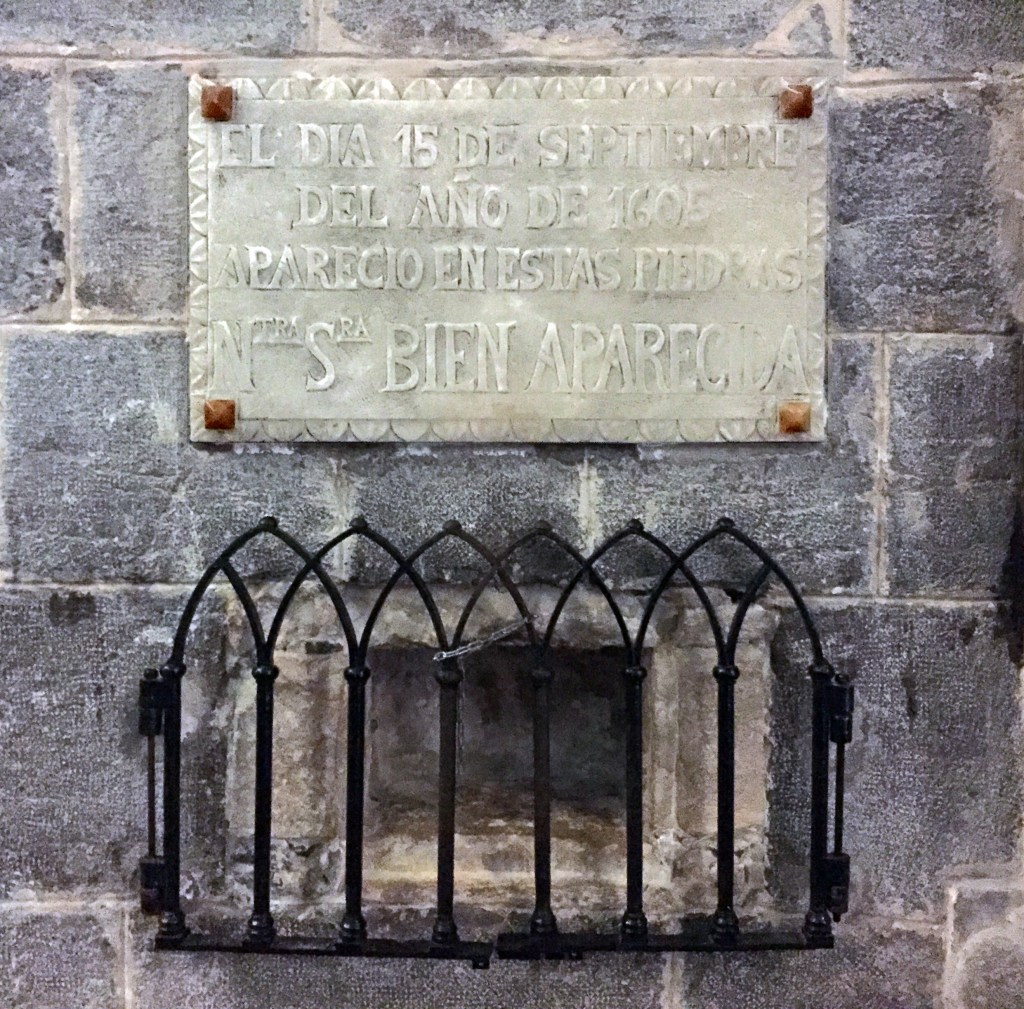
The chronicles refer that, at the beginning of the 17th century, a small hermitage dedicated to Saint Mark existed in that place; and also that, on September 15, 1605, a small image of the Virgin was found in one of its windows. No one ever knew the previous history of that carving. It was only known that the locals picked it up from that window and reverentially deposited it inside the hermitage. Since then, more and more people went to that hermitage to pray to Mary before that image.
THE NAME OF OUR LADY
The story also tells that, before the Marian image was found in the hermitage of Saint Mark, there was (and still is) a very similar carving in the nearby neighbourhood of Marrón; the Virgin of the Sea. It also tells the story that a local, named Rodrigo de Ungos, came to thank the Virgin of the Sea for the favours received and that, seeing this image in poor condition, with good will, he took it to restore. However, out of modesty and with little success, he did not tell anyone.
At the same time that the residents of Marrón, without knowing what had happened, were looking for his missing image, that other carving was found in the hermitage of Saint Mark. This caused a strong conflict, because the residents of Marrón insisted that the latter was theirs, and demanded their restitution.
That dispute gave way to a lawsuit that lasted until Rodrigo de Ungos, upon returning the already restored Virgin of the Sea and realizing the mess that his performance generated, asked for forgiveness and clarified that the image found in the window of the hermitage of Saint Mark was another and different from the one he took with him. Therefore, the neighbours around the hermitage were able to affirm what, without a doubt, was demonstrated: that their image «was not stolen, but appeared and… well appeared!» It is the reason for its name.
THE CARVING
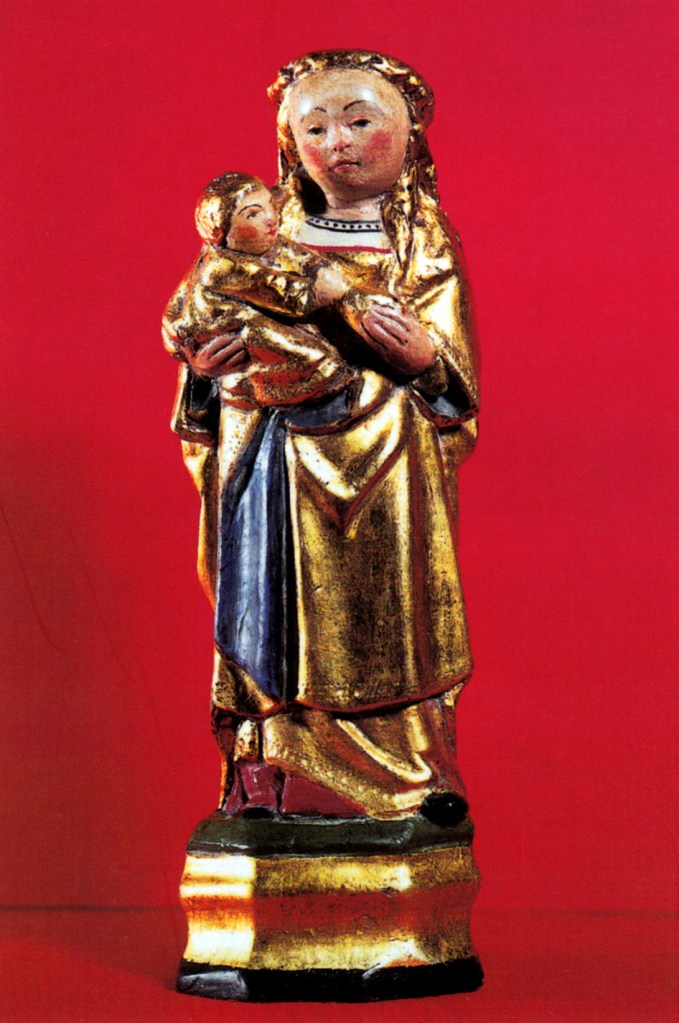
Our Lady Bien Aparecida is a small image 21.6 centimetres high. It was sculpted, gilded and polychrome according to the dictates of the Flemish Gothic style of the 15th century, probably in the current Belgian city of Mechelen.
It is said that at that time and in that place there were artisan workshops that sculpted sacred images for the bourgeoisie —which had great purchasing power thanks to trade— to place them and render private worship in the chapels and oratories of their palatial houses.
The image of Our Lady Bien Aparecida follows the patterns of those workshops. Small in size because it is for domestic use, with the Child on her right arm and dressed in the clothes typical of the Flemish women of that time. It has the peculiarity of the candid gaze of the Virgin to the Child while she offers him what appears to be a loaf of bread.
Among the carvings of the Mechelen workshops that reached the Iberian Peninsula is, in addition to the Bien Aparecida, the previously referred Virgin of the Sea. It is the reason why there was confusion at the time between the two and that was the origin of the name of the Bien Aparecida.
THE SANCTUARY
With the passage of time the smallness of that hermitage was insufficient to accommodate so many pilgrims. Therefore, at the beginning of the 18th century, the current sanctuary was erected on the site of the old hermitage. This new temple was built in the Baroque style following the lines of Juan de Rivas Puente.
Outside the temple stands out its sober FAÇADE, as well as majestic, in calcareous stonework. It is crowned with a bell gable-shaped bell tower.
The interior of the temple, proportionate and welcoming, is presided over by a magnificent CENTRAL ALTARPIECE in the Churrigueresque style, the work of Raimundo Vélez and Bernardino de la Vega. The theme is eminently Marian; because they place in his central niche the image of Well Appeared with the Child in her arms. On each side of the niche, there are two large and magnificent carvings of the Virgin’s parents, Saint Joachim and Saint Anne. In the upper part of the altarpiece there is a representation of the coronation of the Virgin Mary by the Eternal Father, surrounded by fluttering angels that play in front of the altarpiece and around the scene.
At each end of the temple’s transept are two LATERAL ALTARPIECES, also in the Baroque style. The altarpiece on the left is dominated by the founder of the Trinitarian Order, Saint John of Matha, who is accompanied by the carvings of Saint Thomas Aquinas and Saint John of Nepomuk. Above them is the image of Saint Barbara. In the altarpiece on the right is, in its centre, the sculpture of Saint Joseph, husband of Mary, accompanied by the images of Saint Mary Magdalene and Saint John the Evangelist. A Crucified Christ crowns the whole.
Also on each side of the transept hang TWO LARGE PICTURES made by the Cantabrian artist César Abín in 1955. The canvas on the left is a bucolic representation of the moment when the image of the Virgin was found in the window of the hermitage of Saint Mark. And the painting on the right immortalizes the coronation of Our Lady Bien Aparecida.
In an open arch in the wall and located under the choir there is a beautiful CRUCIFIED CHRIST from the Castilian baroque workshops. The image represents, with great realism, the Crucified at the moment of his death. The eyes are blurred and semi-open, the veins and tendons are marked, and the body is tilted and lying on her arm.
From the choir of the Sanctuary a magnificent romantic ORGAN, made in 1914 by the prestigious workshop of Lope Alberdi and inaugurated by the master Jesús Guridi, solemnizes the sacred liturgy and delights music lovers.
On the side wall, next to the door of the Penitential Chapel and behind a small iron fence, is the SMALL WINDOW («VENTANUCO»). It is the window of the hermitage of Saint Mark where they found the image of Our Lady Bien Aparecida.
(As you enter the church, you will see in the right corner the lighting device for the altarpieces)
THE DEVOTION
Three hundred years after the discovery of the image of Our Lady Bien Aparecida in the window of the hermitage of Saint Mark, in 1905, she was declared Queen and Mother of the Mountain, that is, patron saint of the diocese and, at that time, of Santander province.
Fifty years after the patronage, specifically on Pentecost Sunday in 1955, the bishop of that time, Mr. José Eguinu y Trecu, celebrated the canonical coronation of Our Lady Bien Aparecida in the square of the stations of the capital of the province.
When the Autonomous Community of Cantabria was created, the region’s day was established on September 15 of each year, coinciding with the feast of Our Lady Bien Aparecida.
THE HYMN
Oh dear Our Lady, Bien Aparecida!
You are our queen, give us your favour.
On the top you raised your throne of glory,
lift in our breasts a throne of love.
You have our heaven for You canopies.
You have green fields as a carpet:
Towards You raising thousands of faithful children,
like larks sing songs of love.
Oh dear Our Lady, Bien Aparecida!
Hear our bitter cry if we moan.
Turn the laments into triumphant clamour.
Hear our joyful song with pleasure,
if hymns in your honour spring from the chest.
THE EJACULATORY PRAYER
Our Lady Bien Aparecida,
Queen and Mother of the Mountain,
Pray for us.
MASSES
Working days: 12pm and 6:30pm (from May to October)
Saturdays: 12pm and 6:30pm
Sundays and holidays: 12pm, 13pm and 6:30pm
 Iglesias de Cantabria