Dear visitor and pilgrim; welcome to the Saint Turibius Monastery where nature, history, art and spirituality come together.
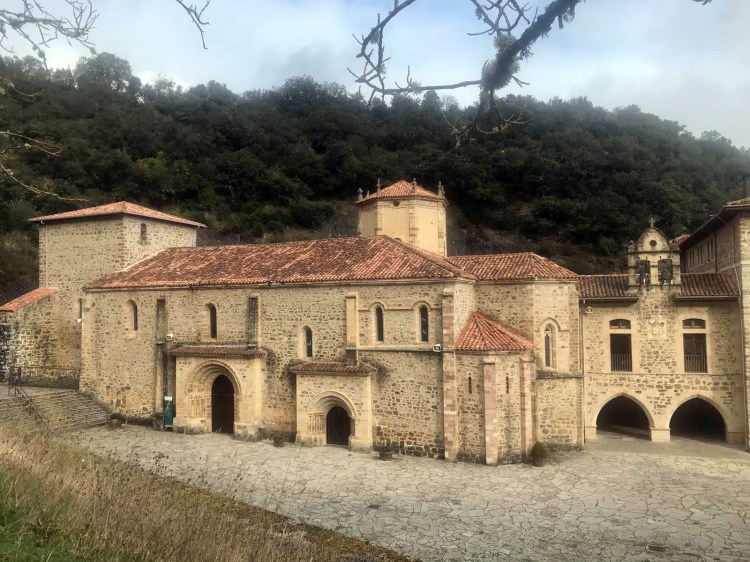
Let us accompany you on this centuries-long journey at the foothill of Mount Viorna, in front of the imposing eastern massif of the Peaks of Europe. Unique place for its spectacular natural wealth, formed by forests, rivers and mountains, which thus offered unique natural protection to the settlement of a small group of monks who came here in the 6th century with Turibius of Palencia in search of solitude and silence.
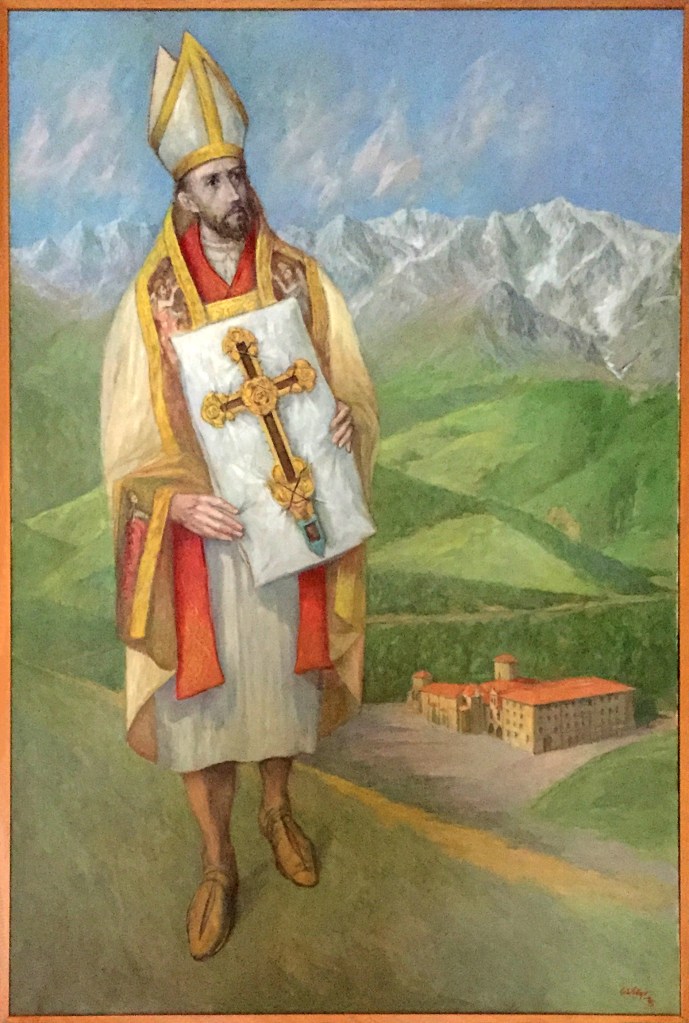
A century before (5th century), there is another man named Turibius de Astorga destined to occupy his part in the history of the monastery. Turibius, leaving his hometown of Astorga, made a pilgrimage to Jerusalem where he remained for a long time when he was appointed Custodian of the Holy Relics (Lignum Crucis) that put us in relation to the events of the year 33 in Jerusalem; the passion and death of Jesus, the Christ.
Due to the Persian invasion of the holy city, Turibius went to Rome taking with him the part belonging to the cross of Jesus. In Rome, Pope Saint Leo the Great appointed him first bishop of the diocese of Astorga. Thus, he returned to his hometown as bishop and bringing the relic with him, deposited it in the Cathedral of Astorga where it was venerated. In the 8th century and due to the Arab domination, it was brought to this Sanctuary as a safe place.
This turned the monastery into an important pilgrimage centre, which is why in 1512 Pope Julius II granted this place the privilege of the Holy Year. It is celebrated every time that April 16, the feast of Saint Turibius, is on Sunday.
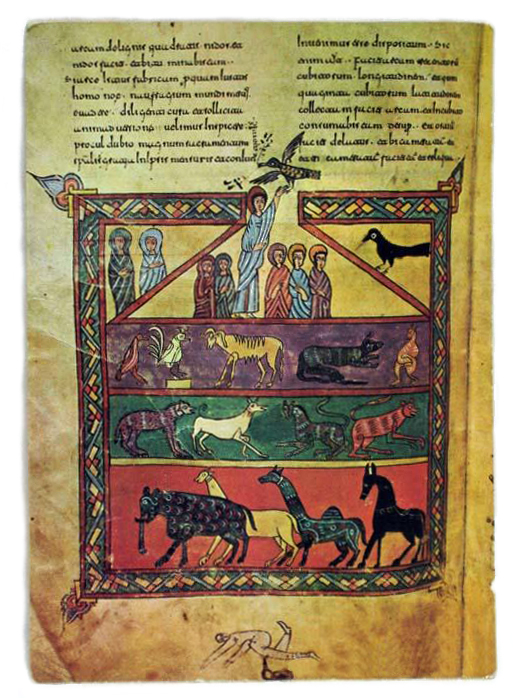
Going back to the 8th century, and in this monastery, a monk named Beato, endowed with exceptional culture, wrote the “Commentary on the Apocalypse” (year 776) which was very important at that time. So important that it was copied in the different monasteries and adorned with some sheets that illustrate the reading of the text. They are the famous «Beatos», of incalculable value, which are preserved in cathedrals or important Libraries around the world. His sheets are called “miniatures”, because the colour of minium prevails in them. It is estimated that there are about 26 codices worldwide. They were made between the 9th and 13th centuries, although there are also from the 16th century. Like Saint John in the Apocalypse, the thesis that Saint Beato wants to spread is that the Lamb will defeat the Beast: the risen Christ will prevail over evil.
For centuries, the Saint Turibius of Liebana monastery was inhabited by Benedictine monks. Because of the Confiscation of Mendizabal, in which the monks were taken from their lands, the community disappeared in 1834. It was necessary to wait until 1961, when it is inhabited by a small fraternity of Franciscan friars. They are heirs of Saint Francis of Assisi, the same one who was pierced by the wounds of passion, becoming one with the person of Jesus whom he loved so much.
It is time to access the temple through the main entrance of the church in the square, if you have not done so already.
Before entering, on your right, you will find the Door of Forgiveness (Romanesque remains of a previous church) and which opens solemnly for the Holy Year of Liebana. It is celebrated in the years in which April 16, Saint Turibius’ day, is Sunday. On that day, the Door of Forgiveness is opened, granting the Jubilee to all who come here. The whole year is a year of indulgence and forgiveness.
When you cross the threshold, you discover the sober and beautiful structure of the Church that is in transition from Romanesque to Gothic in the Cistercian style (13th century). It is the beauty of the essential; light that enters the nave through the windows, the bare stone… The space is very sober, as well as beautiful and harmonious. The church has three apses.
First we go to the right apse that is dominated by a beautiful image of Saint Mary of the Angels (16th century). An image without polychrome that transmits great sweetness and sensitivity: the child Jesus caresses the face of Mary her Mother.
In the central apse the presbytery is presided over by a beautiful icon in Umbrian style: Christ crucified with Mary his Mother and John the beloved disciple. The author is Tomino Conti and it was a gift from Pope Benedict XVI to this monastery as a sign of his closeness to all pilgrims.
On the capitals of this main apse you can see heads of saints or animals, such as the ox and the bear, which according to legend helped Saint Turibius to build the church.
In the apse of the left nave there is a recumbent carving of Saint Turibius made of elm wood with original polychrome from the 14th century. It transmits a deep peace that is born of a beauty without artifice.
You arrive at the Chapel of the Lignum Crucis, the only clearly differentiated space in a temple that stands out for its unity. The chapel is from the 18th century in the Colonial Baroque style.
Its dome stands out on whose pendentives the evangelists and 8 signs of the Passion are represented, which are also repeated on the baldachin where the Cross is exposed. The dome is crowned by a luminous octagonal dome closed by a crown of thorns. To the right of the canopy is the praying statue of Mr. Francisco de Cossío, archbishop of Santa Fe de Bogotá and illustrious son of the nearby town of Turieno, with whose donation this chapel was built.
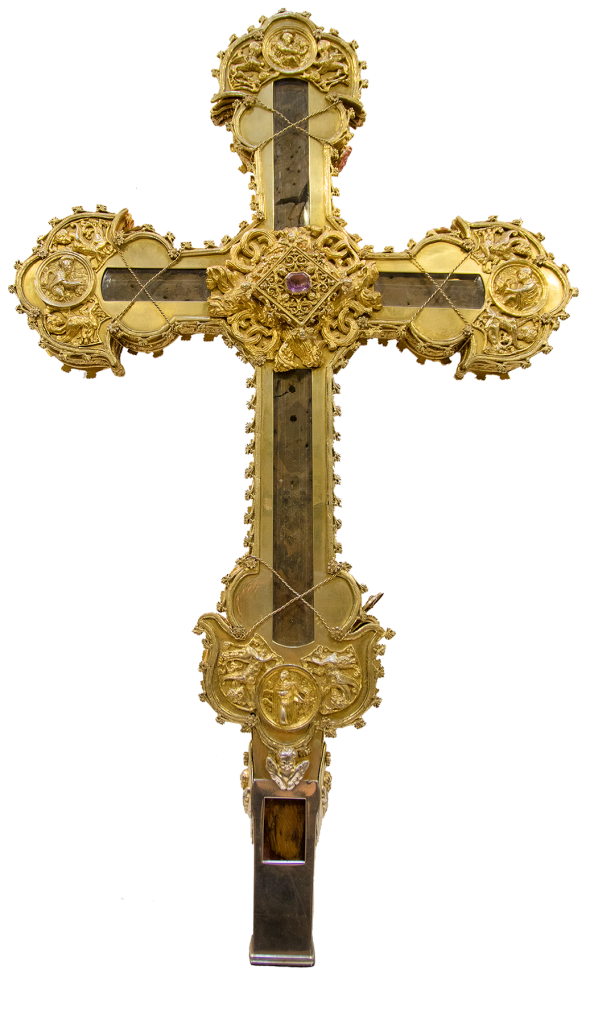
In the canopy located in the centre of the chapel, the Lignum Crucis is venerated; God made man was crucified giving his life for each one of us.
At the foot of this solemn shrine we find the Eucharistic Presence of the Lord in the Tabernacle. He is the living Christ, the same one who gave his life on the Cross.
The Lignum Crucis is the largest preserved fragment of the Cross of Christ, measuring 63 cm for the vertical pole and 39 for the horizontal. Today the log is sawn and placed in the shape of a cross and embedded in a reliquary cross of gilded silver from the 16th century.
Scientific tests carried out in 1958, verified that the wood of the saint log is a Cupressus Sempervirens L, a variety of cypress of Palestine and older than 2000 years.
We are facing the mystery of the cross. For many people the reason for not believing in God is the cross, evil, pain… On the other hand, for us, believers, the cross is the core of our faith. The “Glory” that for us is strength and security, in Jesus crucified appears in the form of ugliness, weakness, poverty, dishonour… It is defenceless love before which the face turns, but it has all the force of love that is goes down and decides to bear the sin of the aggressor.
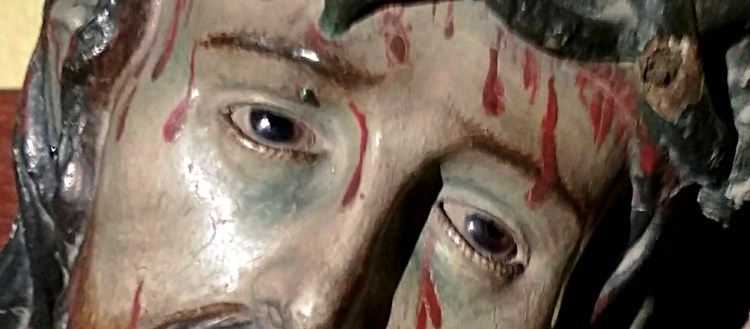
The Father does not put the cross; the cross is the consequence of the hardened heart. The Father puts his faithful presence also there and the son now also radically trusts there.
The cross raises questions to believers and non-believers: What kind of God is the Christian God that his omnipotence is manifested in the most radical impotence? It was all for love…!
If you are a believer, adore the mystery: “He loved me and gave himself for me”, “My God and my everything” (Saint Francis of Assisi). If you are not, I could propose a non-believing prayer: “If you exist, manifest yourself”.
Before leaving the temple, we invite you to have a moment of recollection and prayer, in the Church, in the chapel or in the serene Herrerian cloister on whose walls the reproductions of the most important Beatos hang. If you prefer, you can sit quietly in the welcoming presence of Our Mother, the Virgin Mary, and pray with your heart.
And you, pilgrim, to whom your faith and devotion have made you get here, and before going home, you can visit the nearby hermitages of Saint Michael and Saint Catherine and contemplate the majestic landscapes that surround this place. Listen to the silence to feel the Presence of the Creator.
We hope your visit has been pleasant.

Gospel of the day. EVANGELIZO / IBREVIARY
ROSARY / VIA CRUCIS / VIA LUCIS
Franciscans OFM / Diocese of Santander
MASSES
Every day: 12pm.
HELP US
«For now there are faith, hope, and love. But of these three, the greatest is LOVE» (1 Cor. 13, 13)
If you can much; much. If you can little; a little bit. If you can’t do anything; nothing.
WHEN YOU LEAVE THE CHURCH, MAKE YOUR DONATION. GOD BLESS YOU.
SAINT FRANCIS OF ASSISI’S VOCATION PRAYER
Most High, Glorious God,
enlighten the darkness of our minds.
Give us a right faith,
a firm hope and a perfect charity,
so that we may always and in all things act according to Your Holy Will. Amen.
(Saint Francis of Assisi)
PRAYER FOR PEACE
Lord, make me an instrument of your peace.
Where there is hatred, let me sow love.
Where there is injury, pardon.
Where there is doubt, faith.
Where there is despair, hope.
Where there is darkness, light.
And where there is sadness, joy.
O Divine Master, grant that I may!
Not so much seek to be consoled as to console.
To be loved, as to love.
For it is in giving that we receive.
And it’s in pardoning that we are pardoned. And it’s in dying that we are born to Eternal Life.
(Prayer attributed to Saint Francis of Assisi)
 Iglesias de Cantabria