Dear visitor, welcome to the town of Noja and Saint Peter’s church. This temple was built thanks to the deep faith and great devotion of the inhabitants of this coastal town to their patron saint. Throughout the centuries it has been visited by the parishioners and by countless travellers and pilgrims on their way to Compostela to seek moments of meditation and prayer.
There is no knowledge of the history of Noja before the year 927, but, about the sacred places, there is knowledge of the existence of San Pedruco’s hermitage, located on an islet near Ris beach. From this we can deduce the great veneration of Saint Peter from that time.
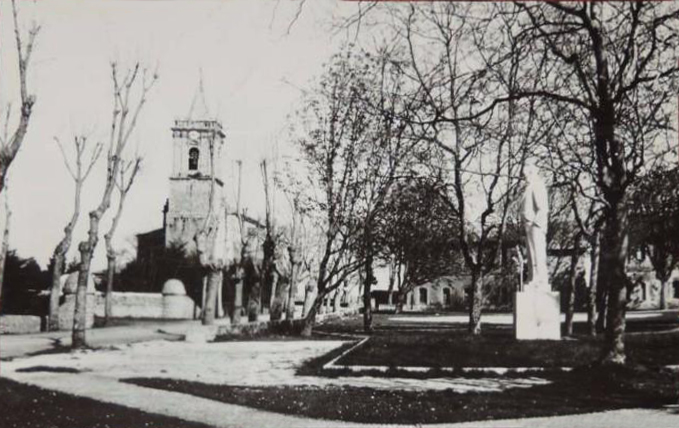
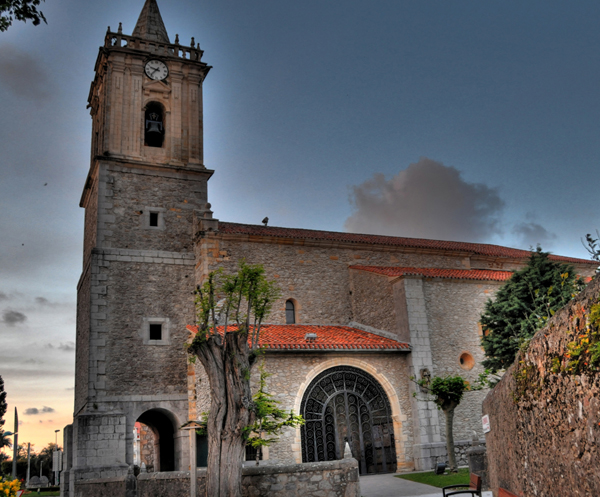
Saint Peter’s parish church was not of private patronage. It was built by the town of Noja in the early sixteenth century on the place that an old high medieval monastery was, near the sea, as the life of its parishioners.
Access the portico through a semicircular arch supported by Tuscan columns, where, since ancient times, the neighborhood council has met. The main entrance of the church is a high quality stonework that opens in a semicircular arch between Tuscan pilasters that support the entablature and the triangular pediment topped with balls. Let’s cross the threshold of the temple and begin our visit. Under the choir is the baptistery, where the baptismal font is, separated from the rest of the temple by a simple grille. Baptism is the foundation of the Christian life. It is the portico of life in the Spirit and the door that opens access to the other sacraments. By the Baptism we are freed from sin and regenerated as Sons of God, incorporated into His Church to be members of Christ. At the top of this baptismal chapel you can see a magnificent painting of the “Baptism of Jesus”.
“I tell you for certain that before you can get into God’s kingdom, you must be born not only by water, but by the Spirit”
Saint John 3, 5
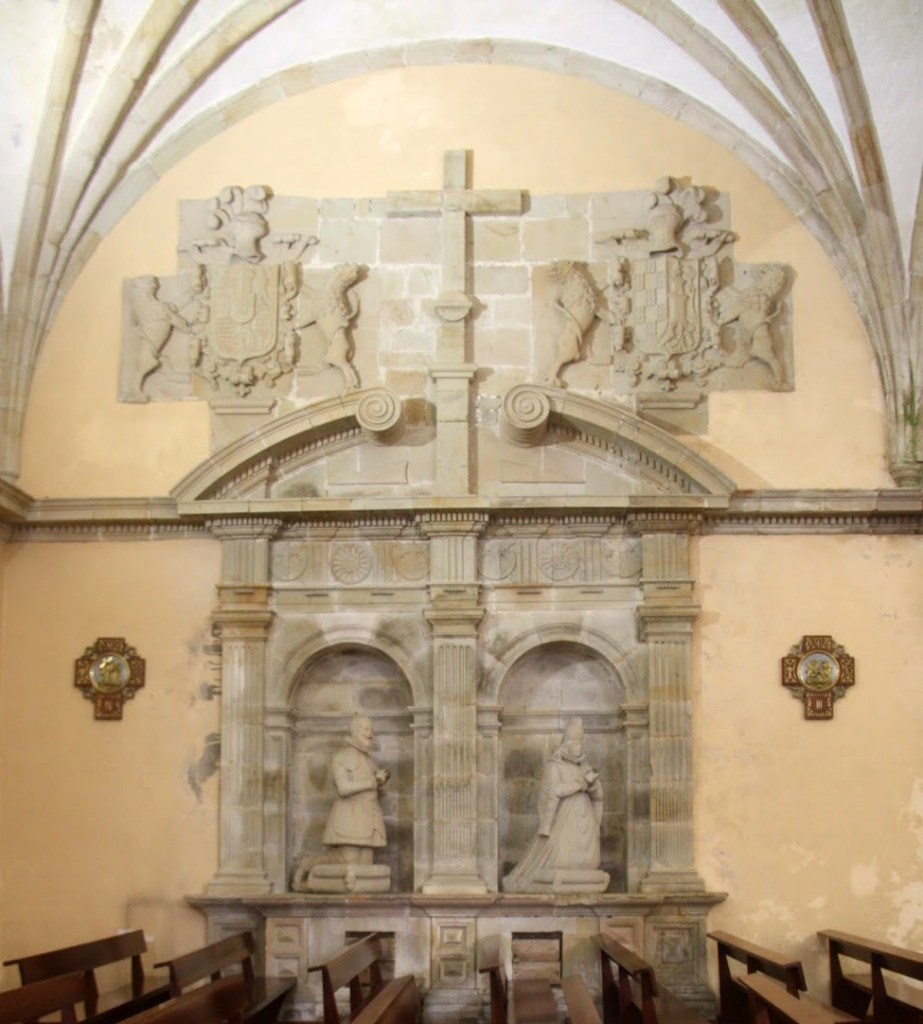
Now let’s start our tour to the head of the temple. In the nave of the Gospel, located to our left, is the Chapel of María Fernández de Isla. It is a beautiful funerary monument with praying sculptures in a curious diagonal arrangement facing the main altar, which represents Mrs. María and her husband, Mr. Gonzalo de Velasco y Castillo, lords of Isla and Noja respectively. The set was carved around 1615 and is topped by a cross flanked with their respective coats of arms.
On the wall opposite to this chapel, in the nave of the Epistle, is the chapel erected in 1635 by the Brotherhood of the Holy Cross, which has great roots in this town. In the ribbed vault the keys have symbols of the Passion: Cross, cock, hammer, pliers and nail. Here is a simple effigy of the Virgin of Sorrows, the suffering Mother of the Lord before the Passion and Death of her son. At its feet we see a magnificent carving of a reclining Christ with articulated arms that, together with the carving of Virgin of Sorrows, participates in the Holy Week processions of the town. Therefore, they are images of great devotion among the inhabitants. At the end of the Good Friday Offices, the brothers perform the descent of the image of Christ placed on a large cross at the head of the central aisle.
The elaborate reliefs of the XIV stations of the Via Crucis are distributed on the side walls. Many times, it seems that the accompaniment of Jesus in his Passion and Death ends in the grave, forgetting that on the third day Christ resurrected and is alive among us forever. VIA LUCIS
“All of you surely know that you are God’s temple and that his Spirit lives in you”
1 Corinthians 3, 16
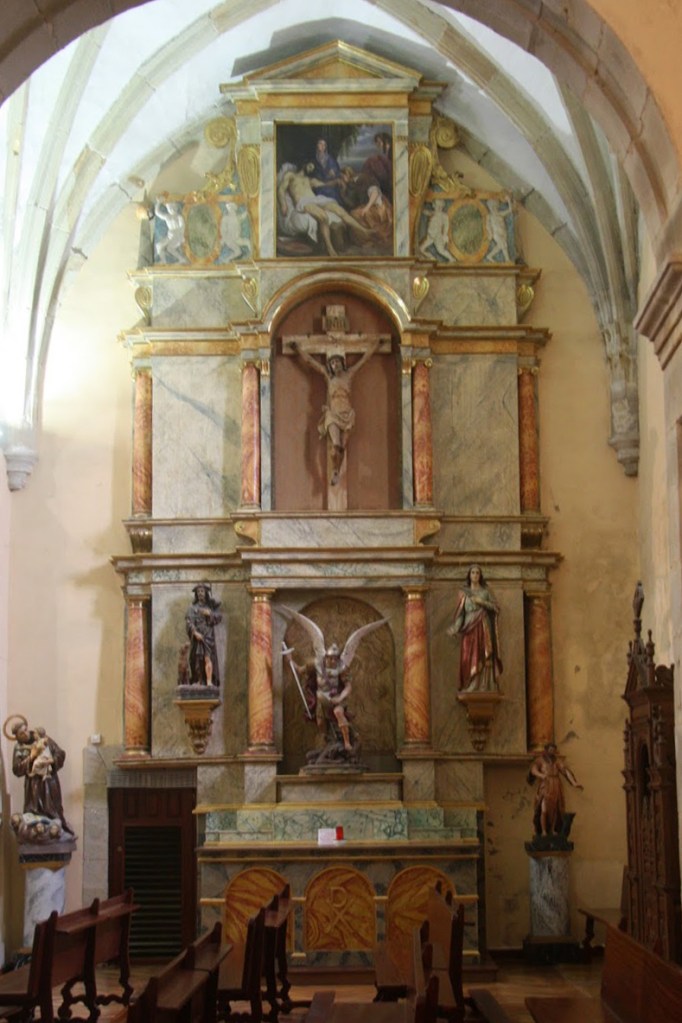
We continue our itinerary until we reach the head of the temple. Before taking a closer look at the main altarpiece, we recommend that you go to the two side chapels built between 1573 and 1576. They are the oldest after the Main Chapel, which is the one located above the presbytery and the altar. The first, on the left side, was originally dedicated to the Virgin of the Rosary; the one on the right side, to Saint Michael the Archangel.
In this right nave is the suggestive altarpiece dedicated to the Archangel Saint Michael, which may be the original altarpiece, although it was extensively renovated in the 19th century. It is presided over by a Crucified, while at the bottom you can see the sculpture of Saint Michael descending to subjugate the demon who, under his feet, tries in vain to stop the attack of the Prince of the Celestial Militia. Escorting the main image are the carvings of Saint Lucy, protector of sight, bearing her eyes that, according to a popular tradition, were taken from her during the martyrdom and Saint Roch showing the sores on his leg and is accompanied by a dog that helped him in times of greatest need. The dog is a sign of divine providence and is always included in the saint’s iconography. The set is finished off by a canvas with the holy women who watch over Jesus after lowering him from the cross. On the sides of the altarpiece, on columns, to the right and left respectively, are the carvings of Saint John the Baptist and Saint Anthony of Padua. The latter is one of the few saints represented with the Child Jesus in his arms.
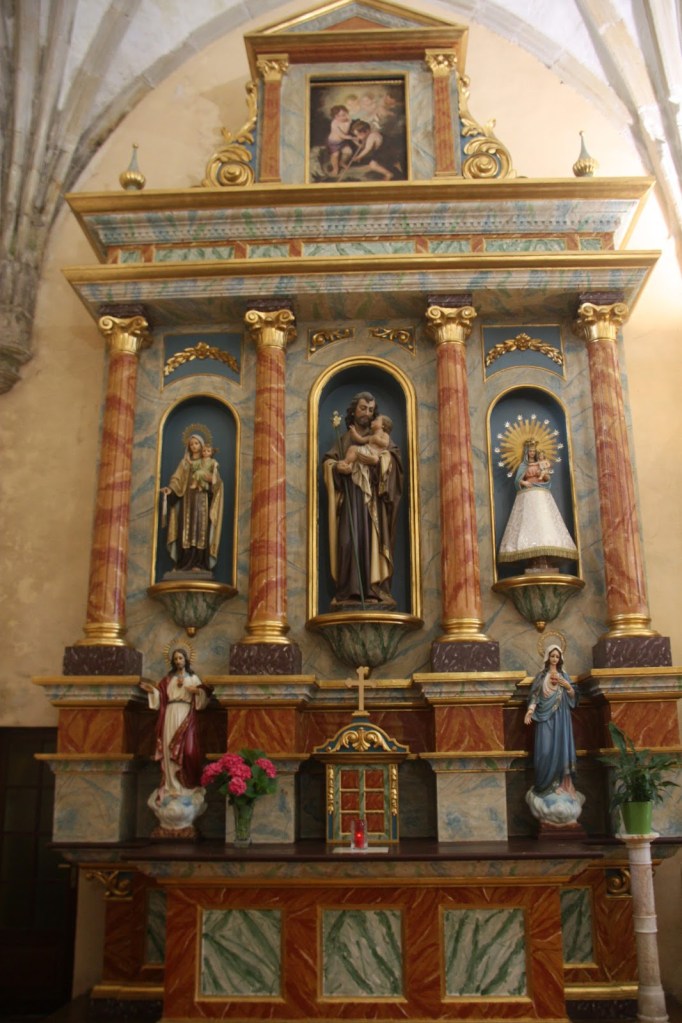
In the opposite nave, the nave of the Gospel, is the altarpiece of Saint Joseph, whose image with the Child Jesus in his arms occupies the central niche. To her left, Our Lady of the Rosary holds her son in her lap and puts her right arm forward, bringing the rosary to us. At the bottom, two beautifully made contemporary carvings of the Sacred Heart of Jesus and the Immaculate Heart of Mary complete the ensemble. Next to them, outside the altarpiece, on a column, we see the image of Saint Francis of Assisi, while a curious image of the Child Jesus and little Saint John occupies the attic.
“Everything will soon come to an end. So be serious and be sensible enough to pray. Most important of all, you must sincerely love each other, because love wipes away many sins.”
I Peter 4, 7-8
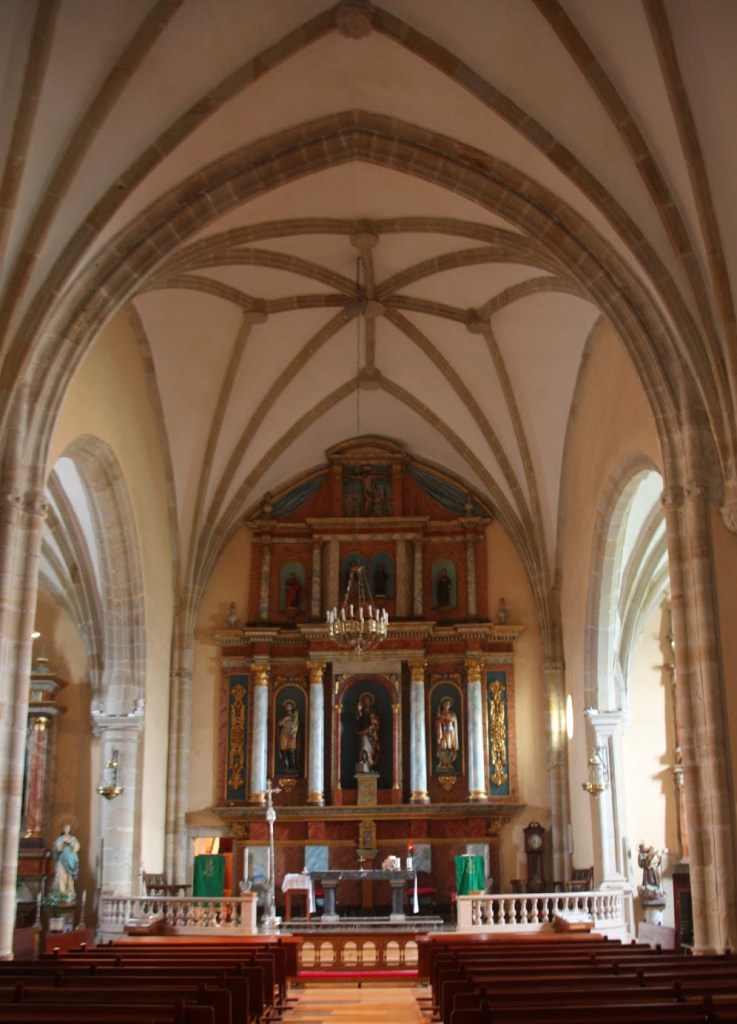
We have almost covered the entire temple and we are sure that you have discovered themes and figures that you did not know, but we can still contemplate the main altarpiece dedicated to Saint Peter, to whom the temple is dedicated. The Apostle Saint Peter is the patron saint of sailors and fishermen, which reminds us of the ancient seafaring tradition of this town.
The central niche of this simple Baroque altarpiece is occupied by the image of Saint Peter represented as a humble fisherman. The saint holds the keys of Heaven in his left hand and blesses with his right hand. Escorting him, we can distinguish the carvings of the Holy Martyrs, Saint Emeterius and Saint Celedonius, with the palm of martyrdom and wearing a military uniform, because both brothers were active in the Roman legions. Upon converting and publicly professing their Faith in Christ, they were beheaded at the end of the third century under Diocletian. Later, in order to protect them from Arab incursions, their relics were brought to Cantabria and since then they are venerated in the Cathedral of Santander. Since those times they have been patrons of the Diocese of Santander and the town of Noja. As a curiosity, the name of Santander is a derivation of Saint Emeterius.
In the upper body we can distinguish, from left to right, the carving of the beloved disciple, Saint John the Apostle, with a red cape and the Gospel in his hands. In the central part are the 17th century carvings, the Immaculate Conception and Saint Diego of Alcala, who was a very popular Franciscan friar in life among the most humble and gathered the most powerful before his tomb to invoke his intercession. The last image corresponds to an undocumented saint.
Crowning the set, on a background of bluish tones where the city of Jerusalem is represented, we can distinguish Christ crucified. Christ died for us and by his death we are saved and justified. And in the lower part of the altarpiece, the greatest treasure that we can find in this temple seems to go unnoticed, the Eucharistic Presence of the Lord in the Tabernacle. The living Christ has saved and redeemed us; he has freely given us eternal life and is always by our side. On its door, a medallion can be distinguished where the scene of Jesus with Martha and Mary in Bethany is represented.
“Our salvation is a free gift from God and his love for us”
There is not much more to tell you. We hope that your visit has been pleasant, but before leaving the temple to follow your life, we invite you to have a moment of recollection and prayer, in solitude, at the feet of the Holy Christ or in his real presence in front of the Tabernacle.
We put at your disposal some prayers and links that can help you in these moments of internalization. In the same way, you can learn more about the life of the Saints in the altarpieces thanks to the various links in the text.
Upon leaving, we can contemplate again the splendid tower, especially in its last section. It is one of the most outstanding of the Baroque of Cantabria. At the end of the seventeenth century, an Inspector General of the Diocese of Burgos ordered it to be made higher so that it could be seen from the most remote neighborhoods. Since then, it appears on the shield of the town of Noja.
“Prayer is the strength of man and the weakness of God”
Gospel of the day. EVANGELIZO / IBREVIARY
ROSARY / VIA CRUCIS / VIA LUCIS
Prayers for the Way of Saint James
MASSES
Sundays: 12pm. | Working days: 19pm.
HELP US
«For now there are faith, hope, and love. But of these three, the greatest is LOVE.» (1 Cor. 13, 13)
If you can much; much. If you can little; a little bit. If you can’t do anything; nothing.
WHEN YOU LEAVE THE CHURCH, MAKE YOUR DONATION. GOD BLESS YOU.
* * * * * * *
PRAYER TO CHRIST
Here I am, good and gentle Jesus, kneeling before you. With great fervor I pray and ask you to instill in me genuine convictions of faith, hope and love, with true sorrow for my sins and a firm intention to amend them.
While I contemplate your five wounds with great love and compassion, I remember the words which the prophet David long ago put on your lips: “They have pierced my hands and my feet; I can count all my bones.”
SONNET TO CHRIST CRUCIFIED
 I am not moved, my God, to give You love by
 thoughts of heaven that You’ve promised me;
 nor am I moved by thoughts of dreaded hell
 for that alone, to cease offending thee.

 I’m moved to see You on the Cross and mocked
 with every breath; I’m moved to see Your
 body racked with wounds; I’m moved by
 Your affronts and by Your death.

 I’m moved, in sum, by love for You so great
 that I would love You were not heaven there,
 and I would fear You, if there were no hell.

 You need give me no prize to love You thus,
 for even if what I hope I hoped not,
 as I now love You I would love You still.
 Iglesias de Cantabria