In the world there are locations to which human beings have been attracted since time immemorial. They are places that connect the earth with the heights; “Gates of heaven” that allow the human spirit to transcend, to rise towards God. One of them is Saint Mary of Bareyo, an ancestral place of worship and devotion for the people of these lands.
Throughout the centuries, countless people have prayed and healed in this sacred place. Today, you too, dear visitor, pilgrim or traveller, have arrived at this sacred place attracted by nature on your way to Compostela or perhaps, in search of something that not even you know what it is.
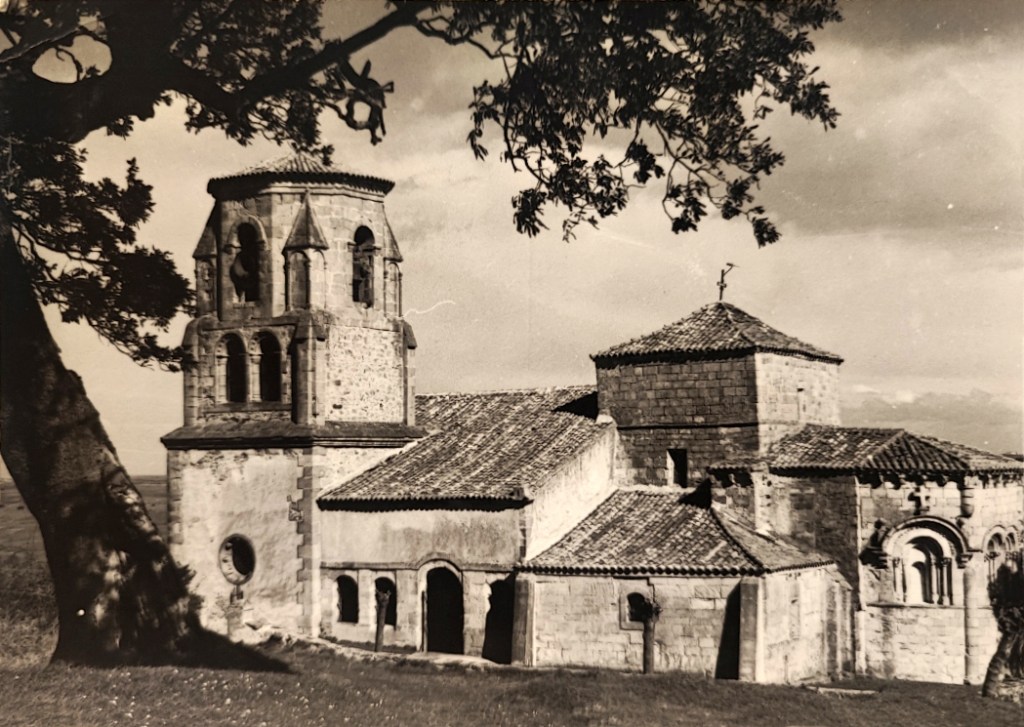
Although there is no documentation that clarifies its origin, we know that the current temple was erected at the end of the 12th century on the remains of a previous building. It was possibly a modest repopulation monastery located on the Jacobean route, independent of Saint Mary of the Port in Santoña and which functioned as a monastic church until the confiscation of Mendizábal. At that time, it became a parish church.
“I am the way, the truth, and the life; no one goes to the Father except by me”
Saint John 14, 6
Before entering the sacred enclosure and delving into this place brimming with energy, art and spirituality, go to the baptistery. It is located to the left of the access to the temple, under the tower. There, we can discover an imposing baptismal font that stands out for its monumentality and its decorative value. It is a baptismal font that, together with that of Saint Mary of the Puerto in Santoña and that of the Collegiate Church of Saint Juliana in Santillana del Mar, is the culmination of the Cantabrian Romanesque. It has a four-lobed bowl, with a ribbed interior and the four fronts decorated with plant themes. In them remains of polychromy are still preserved.
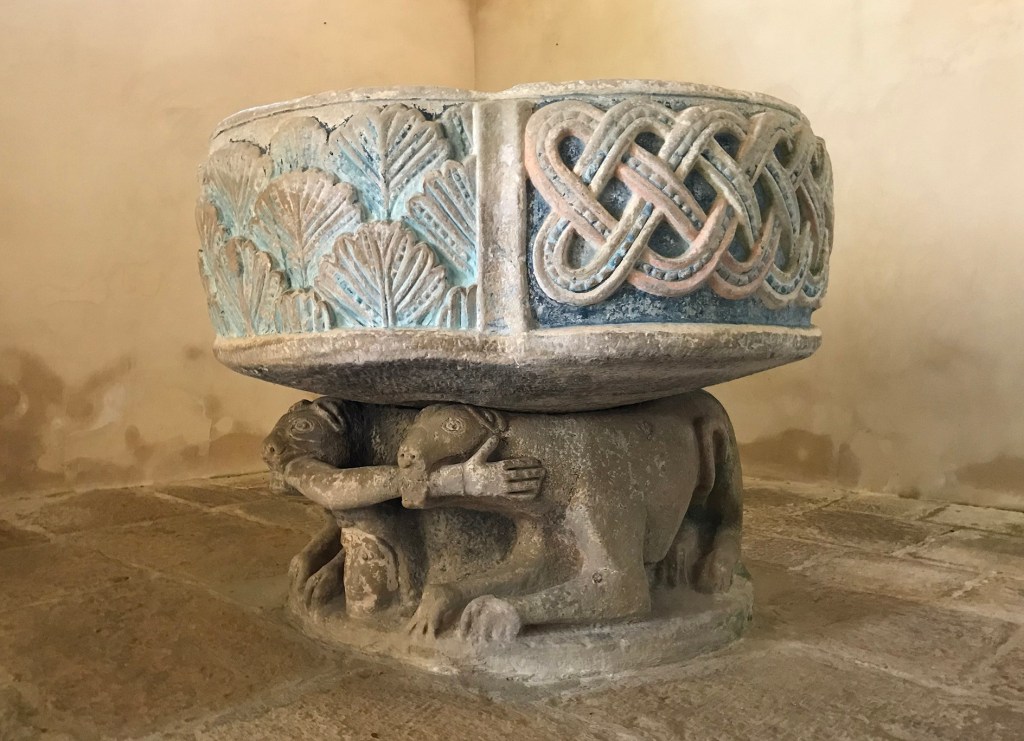
On the north front, loops and counter-loops are represented whose symbolic meaning refers to terrestrial time; short and limited.
The south face is decorated with palmettes and intertwined stems that symbolize the underworld. The neophyte arrives in this world and thanks to Baptism he will be initiated into life in the Spirit.
On the eastern front, we notice a continuous series of smaller loops. It is an infinite repetition whose purpose is to represent Eternity. The person, redeemed by Baptism, wins heaven for Eternity.
We conclude on the west front. It is a set carved in perfect symmetry, repeated yew palmettes, a sacred tree of the ancient Cantabrians and incorporated by the early Christians into their traditions. It represents the final triumph, the ascent to Heaven that the initiate to the Christian New Life receives.
The purpose of giving relevance to regeneration and the new life bestowed with baptism is emphasized in the original decorated pedestal. Two lions hold a human arm in their jaws and a head between them. The androphagous lion devours the old man and returns him to the New Life, because by the Baptism that is received here, the human being is freed from sin, regenerated as a son of God and incorporated into his Church. The sacrament of Baptism is the foundation of the entire Christian life, the gateway to life in the Spirit and the gateway to the rest of the sacraments.
“I am telling you the truth, that no one can enter the Kingdom of God without being born of water and the Spirit”
Saint John 3, 5
It is time to access the church of Saint Mary. It is a Romanesque temple erected between the end of the 12th century and the beginning of the 13th by master stonemasons, possibly from Trasmiera. These artisans created a quite different style and were later called upon to build different churches in Trasmiera, in the Mena Valley and in the north of Burgos.
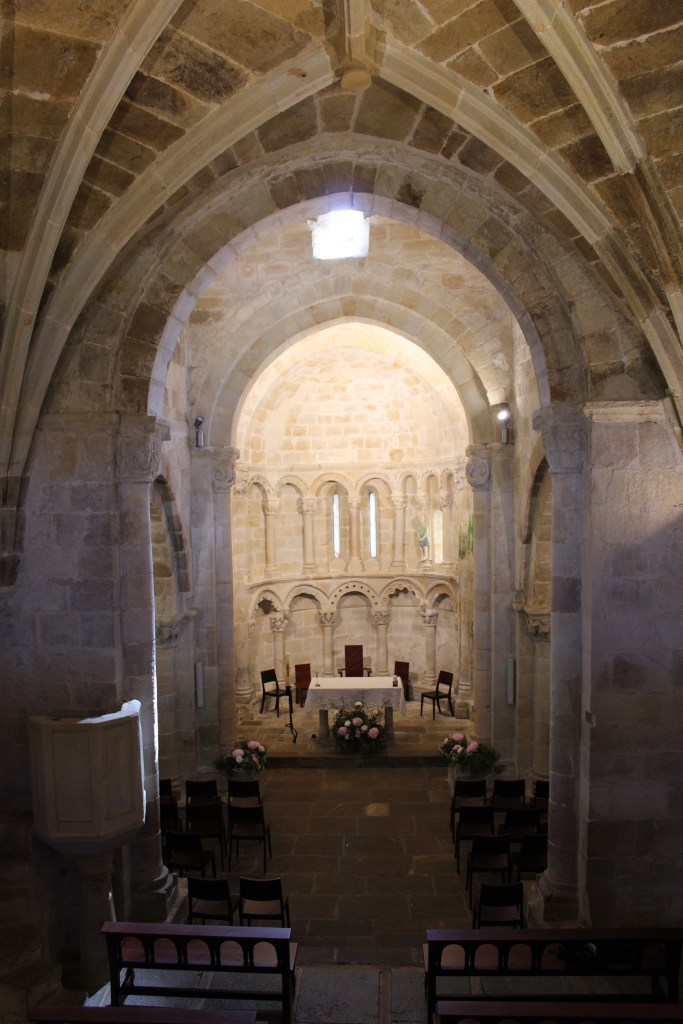
The church has a curious plan, with a single nave, semicircular apse chapels in the transept, dome and chancel formed by a semicircular apse. The singular pseudo transept with curved apses, where the arms of the transept are usually arranged, create a peculiar architectural solution that is difficult to find in Romanesque art. In later times various reforms have been made. In the 16th century the chapel and sacristy were added to the sides of the apse and the ribbed vaults of the nave. The current tower was built in 1930.
In front of the access door of the temple there is a chapel with a square floor plan and a vault with five keystones. Above the altar there is an original tabernacle with the figure of a pelicanon its cover, the quintessential metaphorical image of Christ and the Eucharist. In the upper part, we notice the delicate carving of the Virgin Mary with the Child Jesus in her arms, flanked by the effigies of Saint Blaise and Our Lady of Mount Carmel, patron saints of Bareyo. On the left wall there is a trapezoidal sarcophagus with the inscription “OBIIT FAMULO DEI MUNIO… ERA CXXII PS MLA” -Here lies Munio, the servant of God-. He was possibly a relevant prelate and the date of his death would be the year 984. On the tomb there is a reproduction of Christ by Velázquez. On the opposite wall, you can see the image of the Sorrowful Virgin.
“Come to me, all of you who are tired from carrying heavy loads, and I will give you rest. Take my yoke and put it on you, and learn from me, because I am gentle and humble in spirit; and you will find rest. For the yoke I will give you is easy, and the load I will put on you is light.”
Saint Matthew 11, 28-30
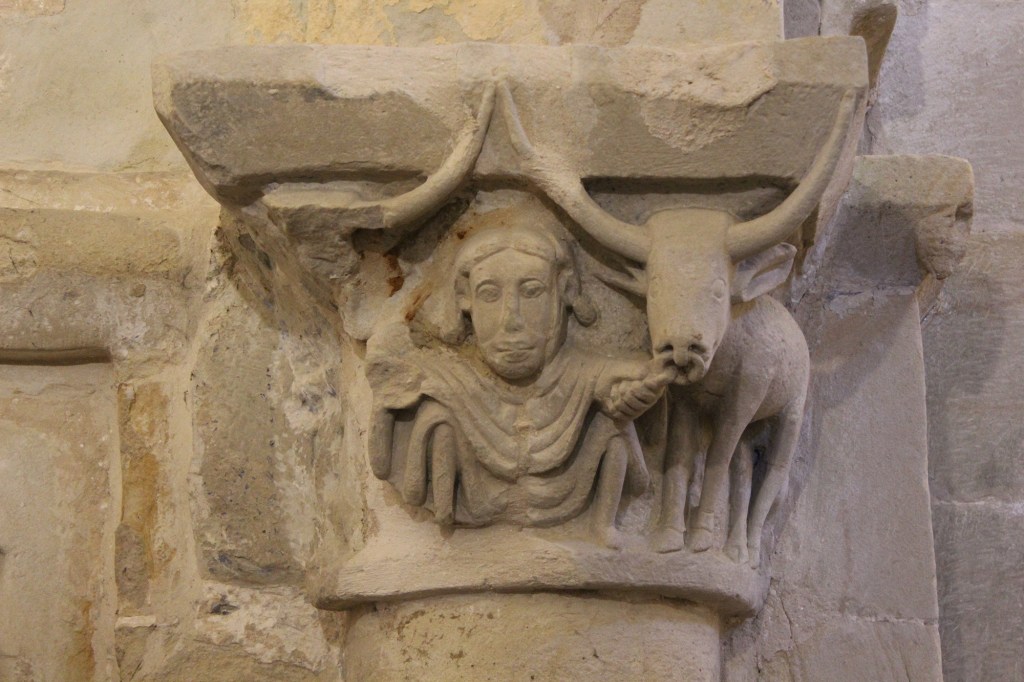
Passing the triumphal arch we enter the space of the pseudo transept. At its ends there are two semicircular apsidioles covered with oven vaults. It is a strange arrangement in Romanesque planimetry. All is covered by a dome that rises above the transept, with a clear symbolic and functional purpose. To our left, in the apse of the Gospel, stands out the capital where a crouching human figure holds two long-horned bulls. It represents the domain of telluric energies, because the bull is the archetypal figure of the earth and its forces. To the left of this column and capital, on the inner wall of the apsidiole, we discover a bas-relief with the seated figure of an angel with great wings. He carries a closed book, indicating that there is always something to unravel in the spiritual search.
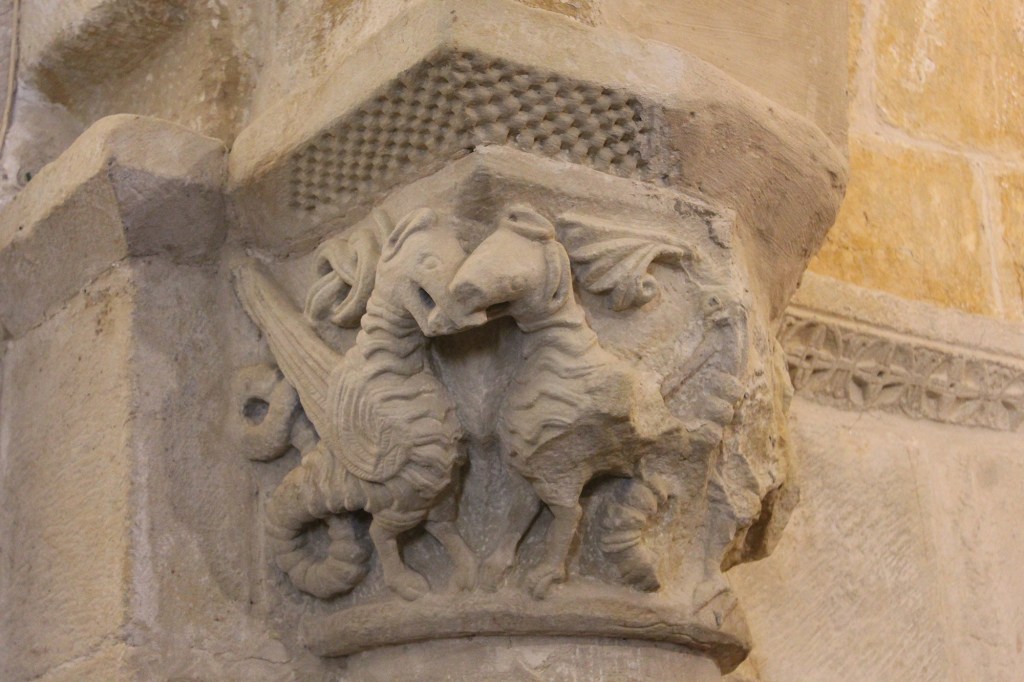
In the opposite chapel we can distinguish an original capital with intertwined fantastic animals that fight among themselves. They usually represent the sin of anger and also seem to indicate that at the base of that column there is a crossroads of telluric currents. It should be mentioned that, like many other Romanesque temples, this sacred enclosure is built on underground water currents that cross under its floor. On the adjoining wall, occupying a semicircular arch niche, we notice a curious carved relief. An old man with a beard and a crown holds a knife and the other figure represents a beardless youth. It could be the scene of Abraham and the sacrifice of his son Isaac, or represent the teacher who transmits his knowledge to the apprentice through a blood pact.
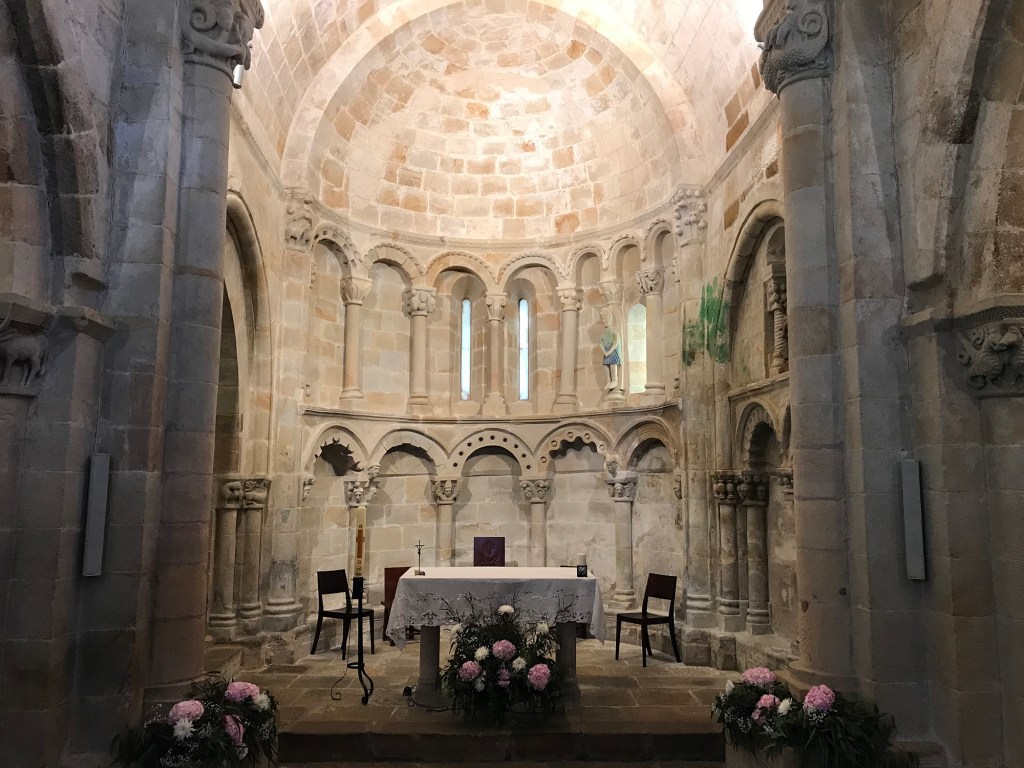
We got to the head. Its apse is embellished with two superimposed blind arcades covered with ashlar shell vault. The upper one is made up of seven peralted arches whose capitals are dominated by plant elements such as apples -symbol of sin- and palms that represent the triumph over sin. We also distinguish human heads that are the saved Christian souls. The capital with the representation of original sin with a classical arrangement in the Romanesque stands out. Adam and Eve, naked, cover themselves with a leaf. They are separated by the tempting serpent that coils around the tree of Good and Evil. A statue-column that retains part of its pigmentation and represents an enigmatic, unidentified character is striking. In the lower arcade of five arches, the twelve heads with serene faces that could correspond to the apostles and a bishop characterized by his mitre predominate. In the central arch, the decoration of rosettes with eight petals alluding to heavenly life stands out.
On the Epistle side, in one of the capitals above the arch that leads to the sacristy, we can see different scenes related to the Resurrection de Christ: the faces of the three Marys, the perfumed pots, the empty tomb, lamps and angels, three sleeping soldiers and on the last capital, two people observe the scene.
“For God loved the world so much that he gave his only Son, so that everyone who believes in him may not die but have eternal life”
Saint John 3, 16
In the 17th century, a chapel with a square floor plan and a simple altarpiece was opened on the opposite wall. Its side streets are occupied by the effigies of Saint John the Baptist and the apostle Saint Bartholomew. These images accompany the carving of a Crucified Christ. At his feet, in the lower part of this sculptural ensemble, is the tabernacle where the greatest treasure, the Eucharistic Presence of the Lord in the Tabernacle, that we can find in this temple seems to go unnoticed. The living Christ has saved and redeemed us, he has freely given us eternal life and he is always by our side.
“Our salvation is a gift of the blood of Christ, because everything is a free gift of God and his unconditional love for us”
We don’t have much more to tell you. We hope your visit has been pleasant. Before leaving the temple to continue your journey through Cantabrian lands, we invite you to have a moment of recollection and prayer before the presence of the Lord in the Tabernacle. For this, we put at your disposal some prayers that may be useful to you.
After your visit to this temple built by the people for the greater Glory of God, you can enjoy the great sanctuary that God has given us. Contemplate the landscape, listen to the silence, walk alone or in the company of the people you love and let yourself be filled with the presence of the God of Life, origin and goal of our existence.
Diocese of Santander / Prayers for the Way of Saint James
Hostel of Güemes / Terra Áurea
Gospel of the day. EVANGELIZO / IBREVIARY
ROSARY / VIA CRUCIS / VIA LUCIS
MASSES
Sundays and holidays: 12pm.
TEMPLE
- From July 15 to September 15
- From 10:30 a.m. to 1:30 p.m. and from 4:00 p.m. to 7:30 p.m.
- Closed on Mondays.
- Free admission, voluntary donation.
CONTACT
- Camino Real 130. 39170 Bareyo (Cantabria)
- Tel: 942 621 181 (Marisol)
- Tel: 687 697 917 (Ernesto)
HELP US
«For now there are faith, hope, and love. But of these three, the greatest is LOVE» (1 Cor. 13, 13)
If you can much; much. If you can little; a little bit. If you can’t do anything; nothing.
WHEN YOU LEAVE THE CHURCH, MAKE YOUR DONATION. GOD BLESSES YOU.
PILGRIM BLESSING
O God, you brought your servant Abraham out of the city of Ur of the Chaldeans, kept him on all his pilgrimages, and were the guide of the Hebrew people through the desert. For this reason, we ask you, through the intercession of Saint Mary, before whose grave we are, to deign to guard these children of yours who, for the love of your name, make a pilgrimage to Compostela.
Be a companion on the road for them, guide at the crossroads, breath in tiredness, defence in danger, shelter on the road, gentle breeze in the heat, shelter from the cold, light in the dark, comfort in their discouragements and firmness in their purposes so that, with your help, they reach the end of their journey well and, enriched with graces and virtues, they return home safe and sound, filled with eternal joy. Through Jesus Christ our Lord. Amen.
REMEMBER
Remember, O most gracious Virgin Mary,
that never was it known that anyone who fled to your protection,
implored your help or sought your intercession,
was left unaided.Inspired with this confidence,
I fly to you, O Virgin of virgins, my Mother;
to you do I come, before you I stand, sinful and sorrowful. O Mother of the Word Incarnate, despise not my petitions,
but in your mercy hear and answer me. Amen.
 Iglesias de Cantabria