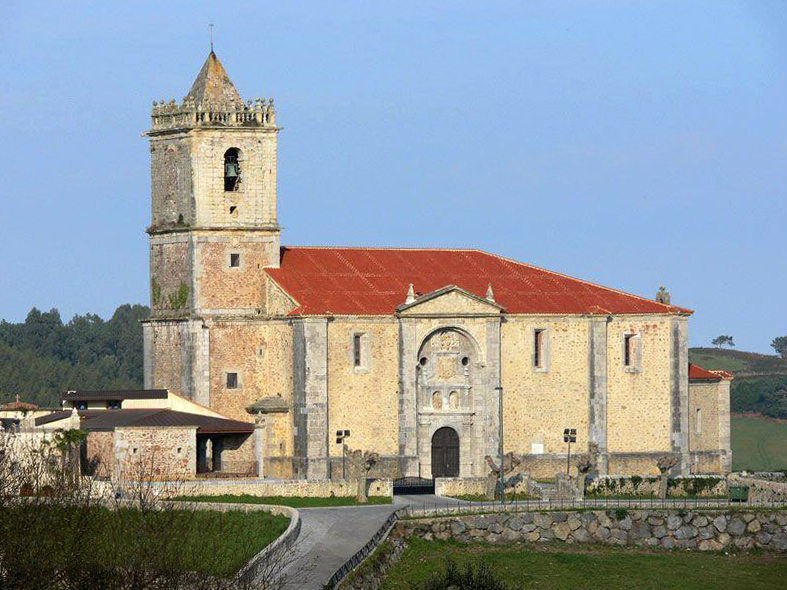
In the highest part of Isla, dominating the historic centre, stands the parish church dedicated to Saints Julian and Basilissa, where you have arrived after searching through family traditions, following a spiritual search or simply being attracted by the extraordinary places that around us. We welcome you and invite you to visit this magnificent temple, perhaps the most outstanding example of a hall church in Cantabria.
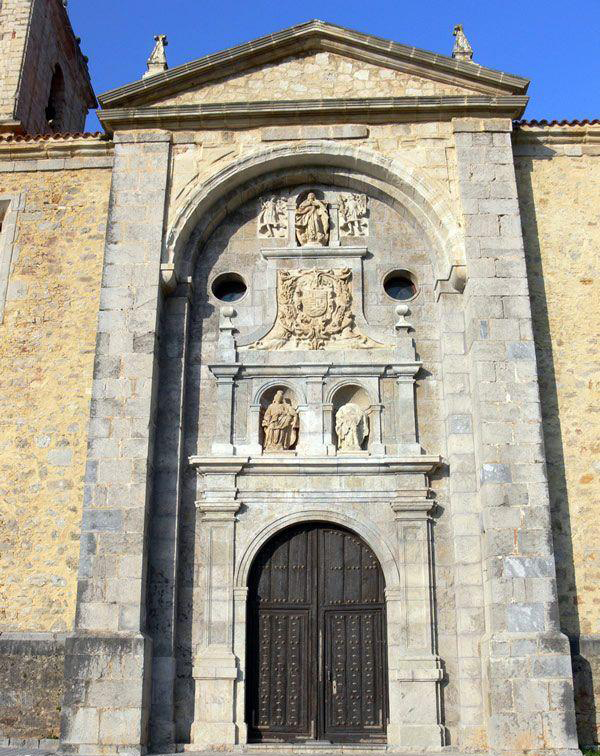
Before entering the temple, contemplate the monumental main façade composed of four floors and inspired by the treatises of the time. Above the door there are two niches with the deteriorated images of the patron saints of the temple. Above them, there is the archiepiscopal shield and topping the set, a representation of the Assumption of Mary between two angels. The ensemble is framed in a large semicircular arch and topped by a triangular pediment. His style fully responds to baroque conceptions.
Now we will explain you a little history before entering this place brimming with art and spirituality. In the oldest known documents -dated in 1210- it is already known that the medieval monastery of Isla was dedicated to Saint Julian, Patron Saint of Auvergne, in the old Kingdom of France. His cult spread along the Way of Saint James, highlighting his monastic character. Next to the church is the Saint Julian’s old Pilgrim Hospital whose origin dates back to the 16th century. Isla was a passing place for the Way of Saint James until its route was modified by Arnuero, leaving this pilgrim hospital hostel in disuse until two years ago, when the City Council put it back into use for pilgrims who pass through Isla.
“If you are tired from carrying heavy burdens, come to me and I will give you rest. Take the yoke I give you. Put it on your shoulders and learn from me. I am gentle and humble, and you will find rest. This yoke is easy to bear, and this burden is light”
Saint Matthew 11, 28-30
The current temple was erected at the beginning of the 17th century on the previous temple and the work was promoted by the archbishop of Burgos, Juan Fernandez de Isla, to solve the dispute between the Council and the Counts of Isla, a family to which it belonged.
The structure shows a “hall plan” or hallenkirche, with three naves of the same height divided into four sections and with robust octagonal columns that support the ribbed vaults creating a set that envelops us. Its dimensions are impressive. The harmony of the space and the height of its naves make this temple one of the most relevant examples of religious architecture in Cantabria.
The visit to the temple begins in the nave of the epistle, located to the right of the main entrance. At its head there is the altarpiece of the Crucifixion where, on the blue-toned drawing of the city of Jerusalem, we discover the sober carving of “Christ Crucified”. On his left there is a simple image of the Virgin of Sorrows, the Mother of the suffering Lord before the Passion and Death of her son, while on his right you can see Saint Mary Magdalene, an icon of hope, because she was the first person who he contemplated the Risen One.
In our country and throughout the Catholic world, the veneration of “Christ Crucified” is very common. The people know that the Christian proclamation is anchored on a cross and that in it Jesus freed us from sin and death by giving his life for us. The image of Saint Philomena appears on the bench and is venerated with great devotion by the people of Isla every August 11.
“God loved the people of this world so much that he gave his only Son, so that everyone who has faith in him will have eternal life and never really die”
Saint John 3, 16
To his right the altarpiece of Saint Anthony of Padua, one of the few saints who is represented with the Child Jesus in his arms. The main carving is accompanied by the images of Saint Joachim and Saint Anne, parents of Mary and therefore, grandparents of Jesus, while at its feet we see a semicircular tabernacle with two bodies as a small altarpiece. The first body presents the Resurrection of Christ on the door of the tabernacle, flanked by the images of Saint Peter and Saint Paul, while in the upper body we distinguish an Ecce Homo between Saint Dominic and Saint Francis. An Immaculate Conception accompanies the whole.
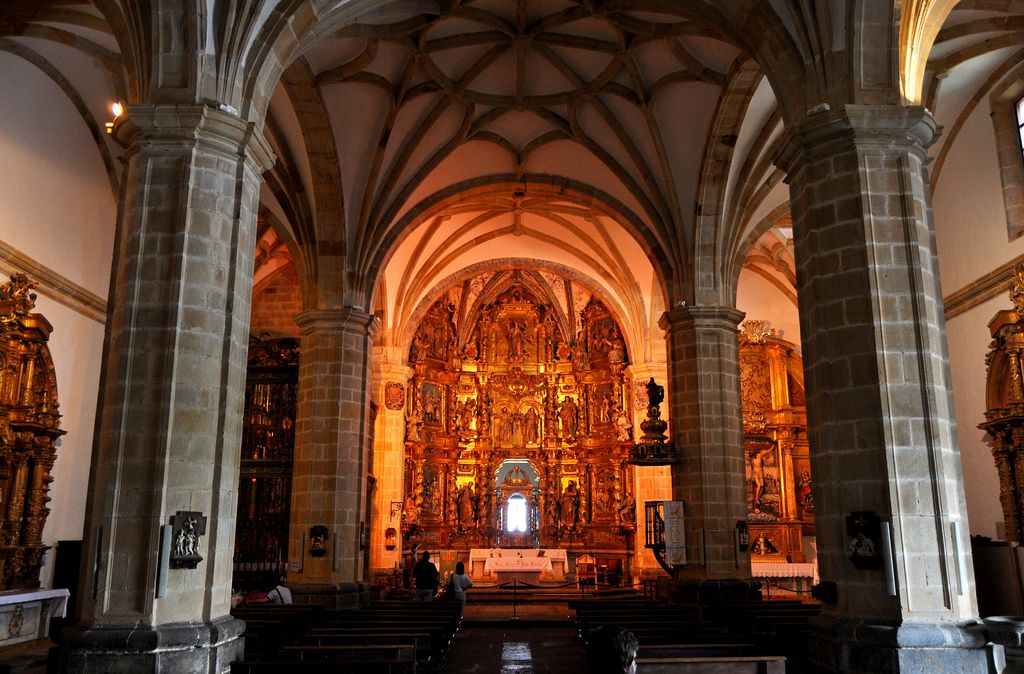
After this tour of the nave of the Epistle, we arrive at the head of the temple. Here you can admire the main altarpiece dedicated to Saint Julian and Saint Basilissa. To admire it in detail, we invite you to take a seat on the front benches or contemplate it from the stairs that give access to the altar. This magnificent altarpiece, made at the end of the 17th century between 1689 and 1697, stands out for its slenderness and its spectacular Solomonic columns, adapting perfectly to the walls of the apse. The structure consists of a lower part, five streets and an attic. Let’s start with the so-called bench, where we discover the reliefs of “The Last Supper”, “The Prayer in the Garden”, “The Arrest” and “The Entry into Jerusalem on Palm Sunday”. All are emotional scenes belonging to the Passion of the Lord.
Six scenes corresponding to the Infancy and Passion of Our Lord are intertwined in the side streets. The reliefs of “Epiphany of the Lord” or adoration of the Magi, “The Flight into Egypt” and “The Descent” occupy the left street from bottom to top; while on the right street is represented “The Adoration of the Shepherds”, “The Flagellation of the Lord” and one of the three falls of Jesus on the way to Calvary.
The seated figures of the Four Evangelists are next to the extreme columns of the first and second body. On the other hand, Saint Ambrose, Saint Augustine, Saint Gregory the Great and Saint Jerome, Doctors of the Church, are in the recesses of the attic.
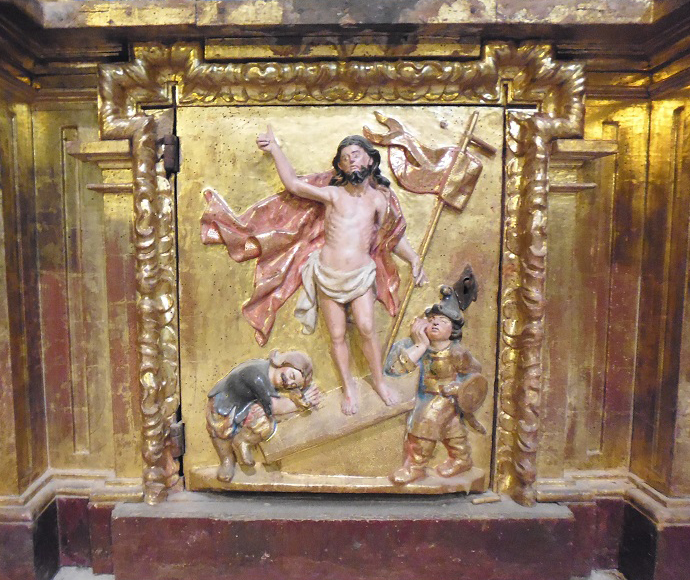
In the first body, flanked by the sculptures of Saint Peter and Saint Paul, there is the tabernacle, an original free-standing piece in the form of a domed canopy that is placed in front of an open space in the sacristy providing luminosity to the whole. On the tabernacle we can see the representation of Faith, while in the lower part the relief of the Risen Christ stands out.
In the second body, the Archangel Saint Michael and the Apostle Saint John accompany the holy spouses to whom the temple is consecrated. The effigies of Saint Julian and Saint Basilissa occupy the central niches and carry the palm, a symbol of their martyrdom that occurred in Antinopolis, Egypt, during the persecution of Diocletian. Since those times, they have been an example for Christian families because of their lifestyle in following Christ.
Finally, crowning this magnificent ensemble, you can admire the beautiful and delicate image of the Assumption of Mary that represents the moment in which the Virgin Mary, at the end of her life, is taken to Heaven in body and soul. Six angels transport her to the Glory and crown her Queen of Heaven. The attic is topped with the figure of the Eternal Father who is represented as an old man with a gray beard and crowned by a triangle. In his left hand he holds a sphere of the world, while with his right hand he blesses us by lifting three of his fingers. It is a sum of Trinitarian signs.
“Let your hope make you glad. Be patient in time of trouble and never stop praying”
Romans 12, 12
After this rest, we continue our visit to the nave of the Gospel. At its head, behind the sober iron gate, is the chapel of the Holy Sacrament, where the burials of the family of the Counts of Isla are located. On the north wall there is the monumental sarcophagus where the coat of arms of Archbishop Fernandez de Isla stands out. Presiding over the Archbishop’s Chapel and the Isla House we can see the altarpiece dedicated to Saint John the Baptist in whose attic is “The Visitation” of Mary to her cousin Saint Elizabeth, the Baptist’s mother. The scene is flanked by the Doctors of the Church, Saint Thomas Aquinas and Saint Teresa of Avila.
The splendid central relief represents “The Baptism of Christ”, on whose sides are the figures of Saint Bartholomew, subduing a demon under his feet, and Saint John of Sahagun. Meanwhile, in the lower part of the set, we distinguish the scene of “The Beheading of the Baptist” and Salome showing the head of the Baptist at the banquet of Herodias. In front of this attractive relief, the greatest treasure that we can find in this temple seems to go unnoticed, the Eucharistic Presence of the Lord in the Tabernacle. The living Christ has saved and redeemed us; he has freely given us eternal life and is always by our side.
“Jesus is alive among us. He is the same yesterday, today and forever”
We are ending our visit where we have combined art and faith. It remains to be seen, in this same nave of the Gospel, the altarpiece of Saint Martin of Tours that appears dressed in Episcopal clothing in the central niche and is escorted by Saint Francis of Assisi and Saint Jerome. Saint Raymond Nonnatus patron saint of pregnant women crowns the set. Next to it is the altarpiece of Our Lady of the Rosary, whose effigy presides over the set. At his side Saint Dominic de Guzman, founder of the Dominicans and Saint Teresa of Jesus. Saint Joseph holding the Child in his hands accompanies the group.
In the second section, you can see a simple rococo-style altarpiece dedicated to Saint Catherine of Alexandria, next to which is the carving of Saint Joaquina Vedruna, founder of the Carmelite Sisters of Charity, and whose order founded a school in Isla town in 1884.
There is not much more to tell you. We hope your visit has been pleasant, but before leaving the temple to continue your way through Cantabrian lands, we invite you to have a few moments of recollection and prayer in the presence of the Lord in front of the Tabernacle. For this, we put at your disposal some prayers that may be useful and various links to better understand the lives of the Saints that are in the altarpieces.
“I adore only and exclusively the God of heaven”
Saint Julian
Gospel of the day. EVANGELIZO / IBREVIARY
ROSARY / VIA CRUCIS / VIA LUCIS
Prayers for the Way of Saint James
HELP US
«For now there are faith, hope, and love. But of these three, the greatest is LOVE» (1 Cor. 13, 13)
If you can much; much. If you can little; a little bit. If you can’t do anything; nothing.
WHEN YOU LEAVE THE CHURCH, MAKE YOUR DONATION. GOD BLESSES YOU.
* * * * * * *
PILGRIM BLESSING
O God, you brought your servant Abraham out of the city of Ur of the Chaldeans, kept him on all his pilgrimages, and were the guide of the Hebrew people through the desert. For this reason, we ask you, through the intercession of Saint Julian and Basilissa, before whose grave we are, to deign to guard these children of yours who, for the love of your name, make a pilgrimage to Compostela.
Be a companion on the road for them, guide at the crossroads, breath in tiredness, defence in danger, shelter on the road, gentle breeze in the heat, shelter from the cold, light in the dark, comfort in their discouragements and firmness in their purposes so that, with your help, they reach the end of their journey well and, enriched with graces and virtues, they return home safe and sound, filled with eternal joy. Through Jesus Christ our Lord. Amen.
REMEMBER
Remember, O most gracious Virgin Mary,
that never was it known that anyone who fled to your protection,
implored your help or sought your intercession,
was left unaided.
Inspired with this confidence,
I fly to you, O Virgin of virgins, my Mother;
to you do I come, before you I stand, sinful and sorrowful. O Mother of the Word Incarnate, despise not my petitions,
but in your mercy hear and answer me. Amen
PRAYER TO OUR LADY OF ASSUMPTION
Mary, Queen assumed into heaven, I rejoice that after years of heroic martyrdom on earth, you have at last been taken to the throne prepared for you in heaven by the Holy Trinity.
Lift my heart with you in the glory of your Assumption above the dreadful touch of sin and impurity. Teach me how small earth becomes when viewed from heaven. Make me realize that death is the triumphant gate through which I shall pass to your Son, and that someday my body shall rejoin my soul in the unending bliss of heaven.
From this earth, over which I tread as a pilgrim, I look to you for help. I ask for this favour: (Mention your request).
When my hour of death has come, lead me safely to the presence of Jesus to enjoy the vision of my God for all eternity together with you. Amen.
 Iglesias de Cantabria