Dear visitor, welcome to the town of Santoña and to the parish church of Saint Mary of the Port. This temple was built thanks to the devotion and deep faith of the people of this town. For centuries it has been visited by many travellers, merchants and pilgrims who, on their way to Compostela, found in it moments of peace, recollection and prayer.
“Since ancient times, Saint Mary of the Port has been the spiritual reference of the residents of Santoña, of the Fishermen’s Brotherhood and of the Sietevillas, sustenance of their faith and consolation in their sadness”
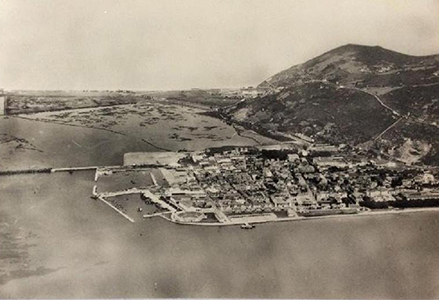
For a long time, the town of Santoña has been one of the reference ports of the Crown of Castile in the Cantabrian Sea and has always been linked to the Jacobean route. There is evidence of the existence of a Benedictine monastery in 836, erected in the 8th century, at the time of the repopulation carried out by the Asturian king Alfonso I. In 968, Santoña was devastated by the Normans who sacked the place. By killing its inhabitants, the monastery was left uninhabited and until the middle of the 11th century it did not have abbot and monks again. Then, it became a religious and social reference.
The first decades of the 16th century were a time of prosperity. The powerful families of the town promoted the extension of the temple; the apse and the transept were demolished to raise the current one in Gothic style.
The church is made up of three naves. The central one is larger, and the wide vaults that open onto the new chapels on the sides, expanded the space for the faithful. Romanesque and Gothic intermingle; the Romanesque on the back and the Gothic with Renaissance touches on the head.
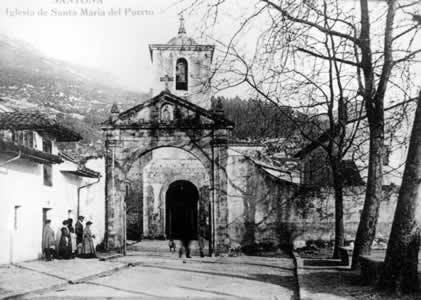
After some knowledge of art and history, let’s cross the threshold of the temple and begin our visit. The temple is accessed through the western façade, where four attached columns with delicate archivolts and capitals support a small tympanum with the figure of Our Lady, the Virgin of the Port.
Now, through the central corridor, go towards the head of the temple and discover the original capitals and the various altarpieces and carvings that occupy the side chapels. If you consider it appropriate, go to these chapels to contemplate them in detail.
“All of you surely know that you are God’s temple and that his Spirit lives in you”
1 Corinthians 3, 16
As soon as you enter, on your left, in the nave of the Gospel, you can see a sober carving of «Christ Crucified» between the images of Saint Peter and Saint Thomas Aquinas.
The adjacent chapel is dedicated to Our Lady of the Rosary, whose carving, with fine features and great serenity, occupies the central niche of the altarpiece. Mary appears as a young mother who presents her Son and puts her right arm forward to bring us her rosary.
The carvings of Saint Roch, protector against plagues and epidemics and dressed in a pilgrim’s habit; and Saint Francis of Assisi, one of the best known saints in the history of the Church and founder of the Franciscan Order, escort the main image. The set is finished off by a Calvary without polychrome. On the side wall, under a majestic coat of arms, you can see a reclining Christ of magnificent carving.
Next, there is the chapel of the Virgin of Guadalupe, patron saint of America and highly esteemed in this fishing village closely linked to the American continent. The beautifully framed canvas of hers occupies the left wall. In front of him, in a splendid flamboyant arch, we discover a beautiful Eucharistic display that once occupied the main altar. The carvings of Saint Christopher and Saint Bridget, patron saint of Europe, accompany it on both sides.
The carving of «Ecce Homo», (Jesus condemned to death) surrounded by a sober and original arch, occupies the central part of the south wall flanked by the images of the Virgin Well Appeared, patron saint of the Diocese of Santander, whose Sanctuary is located a few kilometres from Santoña; and Saint Teresa of Jesus, doctor of the Church.
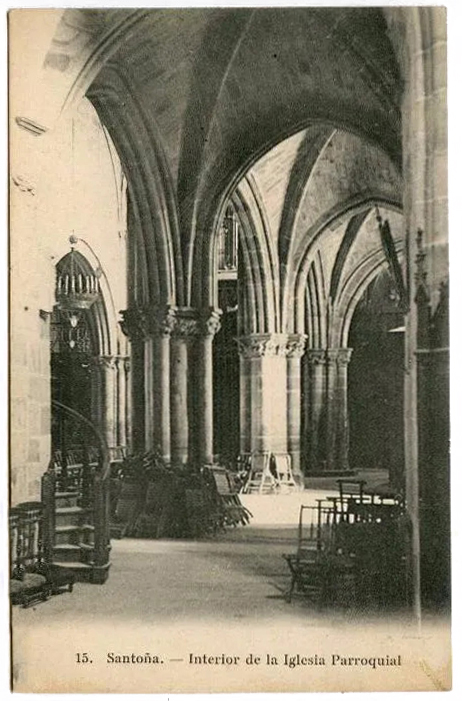
Now look to your right. In the nave of the Epistle there are two chapels of similar dimensions to those already visited. The first is the Chapel of the Virgin of Sorrows. Here is a simple dress image of Our Lady of Sorrows, the Mother of the suffering Lord before the Passion and Death of her son. Next to it, there is an imposing carving of «Jesus of Nazareth with the cross on his back». The sculptures of Saint Francis of Assisi and Saint Anthony of Padua, one of the few saints who is represented with the Child Jesus in his arms, are next to her.
“God loved the people of this world so much that he gave his only Son, so that everyone who has faith in him will have eternal life and never really die”
Saint John 3, 16
In the adjoining chapel you can see a magnificent carving of the Crucified, the Christ of Forgiveness, which has great popular devotion. From the beginning, the faithful people have understood that the Cross is not a defeat, but the prelude to the definitive triumph over death that will come with the Resurrection.
This image takes part in the processions of Holy Week of Santoña, along with the «Ecce Homo», «Jesus of Nazareth», «Reclining Christ» and «Virgin of Sorrows», mentioned previously.
In the first column of the main nave of the church, upon reaching the transept and looking north, you can see the plaque commemorating the last dedication of the temple in 1886. At the foot, under a gothic arcade niche that contains an image of the Virgin, there is the tombstone of Bishop Anthony, “Brother of the Goths”. Although there are many doubts about who this prelate was, the same plaque says «that he consecrated this temple…».
After this tour and discovering themes and figures that perhaps you did not know, we have arrived at the transept of the temple. Perhaps the striking baptismal font, where for centuries the children of Santoña have received the sacrament of baptism, has attracted your attention. Made in the 13th century, it is decorated on the front with the Annunciation and Saint Joseph, while two monks sitting reading a book occupy the back. At the base, two sculpted lions symbolize original sin defeated by Christ when he instituted Baptism. Baptism is the foundation of the Christian life. It is the gateway to the Holy Church and to life in the Spirit.
“No one can enter the Kingdom of God without being born of water and the Spirit”
Saint John 3, 5
In the center of the altarpiece, we can see the image of Saint Peter who, dressed as a pontiff and seated in his Chair, occupies the central niche. Above him, there are Saint James the pilgrim apostle and Saint Andrew, brother of Saint Peter. Crowning the altarpiece, there is a magnificent Calvary. On the right street, there are the reliefs of “Jesus with Saint Peter walking on water”, “the Martyrdom of Saint Catherine of Alexandria” and “the Crucifixion of Saint Peter”. On the left, there are “Saint Peter and Christ with the Cross”, “the preaching of Saint Peter” and “the miraculous liberation of the apostle Peter”.
Accessing the entrance next to the altarpiece, in the back chapel, there is the altarpiece of the Assumption of Mary, which is escorted by the carvings of Saint Gregory the Great and Saint Paul the Apostle. On the altar table, there are two small images of the Infant Jesus of Prague and Saint Lucia. On the south wall of the chapel, you can see a striking sculptural composition of the Holy Trinity.
Before contemplating the main altarpiece, go to the left nave of the transept where one of the jewels of the temple is located, the altarpiece of Saint Bartholomew, dated around 1561. In its side streets, the Flemish panels made by the relevant painter Pieter I Claeissens (from Bruges) stand out. The Flemish origin of the tables may be due to the intense commercial and artistic traffic that developed over centuries between the ports of the Cantabrian Sea and the Netherlands. According to a popular tradition, it was a gift from Emperor Charles V in gratitude for having saved himself from a gale.
The central street and the attic are decorated with sculptural reliefs that, from bottom to top, represent Saint Bartholomew subjugating the devil, the Virgin of the Rosary with the Child in a golden oval, Christ the Saviour and the Crucifixion.
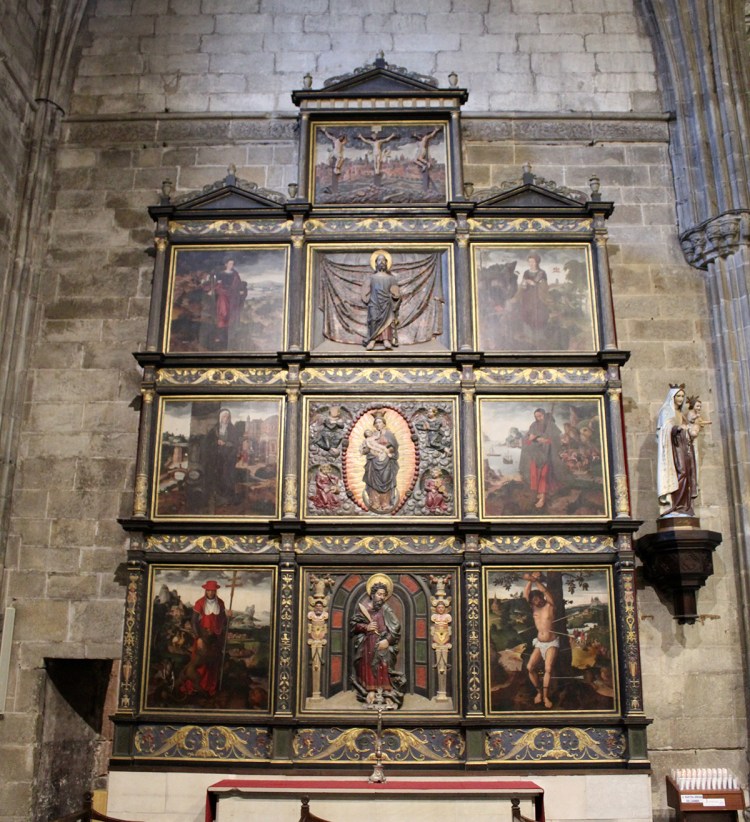
On both sides you can see the aforementioned Flemish tables. On the right side street you can see those of Saint Sebastian, the Apostle Saint James, in pilgrim’s garb, and Saint Mary Magdalene, an icon of hope because she was the first person to contemplate the Risen One. Saint Jerome, with the cross and the lion, Saint Anne at the Golden Gate and Saint Catherine occupy the left street of the complex. Some of these invocations are the same as the names of ships captained by the sailors of Santoña.
To the right, next to this altarpiece, is the image of the Our Lady of Mount Carmel, patron saint of sailors and who is asked to protect them against storms and shipwrecks.
Through the door on the left, you can access a chapel in which is the altarpiece of «The Pieta», which gives it its name, and on whose relief you can see that of «The Virgin Mary with the Child and Saint Anne«, and the carving of the «Eternal Father.» On the north wall, in a niche, you can see «the Virgin of the Galleon», an image of excellent quality and very popular for its relationship with the seafaring life of this town.
“Saint Mary of the Port is an image of great beauty, full of symbolism, which the inhabitants of Santoña venerate for centuries”
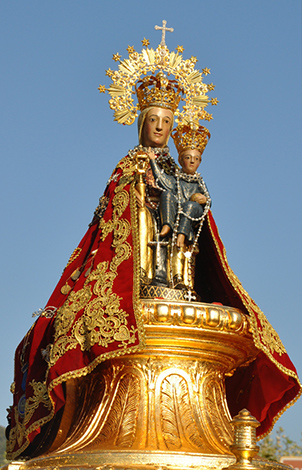
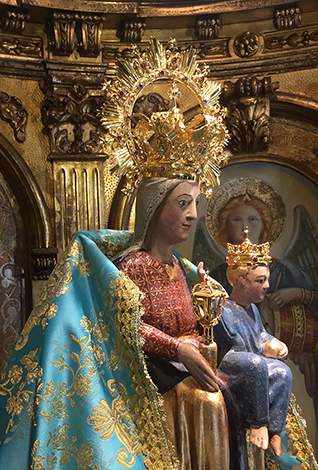
After this tour, you arrive at the head of the temple where its main altarpiece is located. It is presided over by the image of Saint Mary of the Port, to whom the temple is dedicated. It is a delicate seated carving, from the end of the 13th century, with the Child Jesus on his left knee in an attitude of blessing us. Tradition tells that the image was taken to America on the voyage of Discovery by the famous navigator and cartographer from Santoña Juan de la Cosa, owner of the Ship Santa María and author of the first map of America.
Next to the patron saint of Santoña you can see four evangelical scenes from the life of the Virgin; «The Adoration of the Magi» and «The Child Jesus among the Doctors», on the left; and «The Presentation of Jesus in the Temple» and «The Wedding at Cana», on the right. Crowning the set you can see the representation of «Calvary» with its usual iconographic composition; Crucified Christ accompanied by his Mother and Saint John, the beloved disciple.
At the bottom of this sculptural ensemble, where the tabernacle is located, the greatest treasure that we can find in this temple seems to go unnoticed, the Eucharistic Presence of the Lord in the Tabernacle. The living Christ has saved and redeemed us; he has freely given us eternal life and is always by our side.
“Our salvation is a gift of the blood of Christ. Everything is a free gift from God and his love for us”
Our visit ends. We have combined art and faith. Before continuing on your way through Cantabria, we invite you to have a time of recollection and prayer, to sit in silence before the welcoming presence of Our Mother in whose honour this temple was erected, and to meditate on her life of dedication and gratitude. Or you can praise and glorify the Lord in the real presence of him in front of the Tabernacle. We put at your disposal some prayers that will help you in these moments of recollection. In the same way, you can know the life of the Saints located in the murals by clicking on the links in the text.
“And so I say to you: Ask, and you will receive; seek, and you will find; knock, and the door will be opened to you. For those who ask will receive, and those who seek will find, and the door will be opened to anyone who knocks”
Saint Luke 11, 9-10
WEBSITE OF THE PARISH OF SAINT MARY OF THE PORT
Gospel of the day. EVANGELIZO / IBREVIARY
ROSARY / VIA CRUCIS / VIA LUCIS
Prayers for the Way of Saint James
MASSES
WORKING DAYS: 7.30pm.
SATURDAYS: 7.30pm.
SUNDAYS: 11am. / 12.30pm. / 7.30pm.
* * * * * * *
HELP US
«For now there are faith, hope, and love. But of these three, the greatest is LOVE» (1 Cor. 13, 13)
If you can much; much. If you can little; a little bit. If you can’t do anything; nothing.
WHEN YOU LEAVE THE CHURCH, MAKE YOUR DONATION. GOD BLESSES YOU.
* * * * * * *
PRAYER TO SAINT MARY OF THE PORT
Oh Mother of God, You have never ignored the pleas that we have addressed to you on land and sea.
Under the protection of your mantle, your children of these seven villages have felt the lighthouse and the guide that protects them whenever they come to You.
We ask you, Mother and Virgin of the Port, to help us walk with the light of faith, to illuminate our lives and our families in your beloved town of Santoña. Be You, the Rose of the Winds that assures the voyage of our peoples of the sea and the glory of our living.
PRAYER TO OUR LADY OF MOUNT CARMEL
O most beautiful Flower of Mount Carmel, Fruitful Vine, Splendour of Heaven, Blessed Mother of the Son of God, Immaculate Virgin, assist me this my necessity. O Star of the Sea, help me and show me herein you are my Mother.
O Holy Mary, Mother of God, Queen of Heaven and Earth, I humbly beseech you from the bottom of my heart, to succour me in this necessity; there are none that can withstand your power.
O, show me herein you are my Mother, O Mary, conceived without sin, pray for us who have recourse to thee. (3 times)
Sweet Mother, I place this cause in your hands. (3 times)
 Iglesias de Cantabria