Dear visitor, welcome to the town of Laredo and its church of Assumption of Mary. This temple was built thanks to the deep faith of the people of this noble town. Over the centuries, it has been visited by its parishioners, by distinguished travellers and merchants who have come to the port of Laredo from distant places, and by countless pilgrims on their way to Compostela to seek moments of peace, recollection and prayer.
“For a long time, Saint Mary has been the spiritual benchmark for the residents of Laredo, the support of their faith and the sublimation of their happiness and sadness”
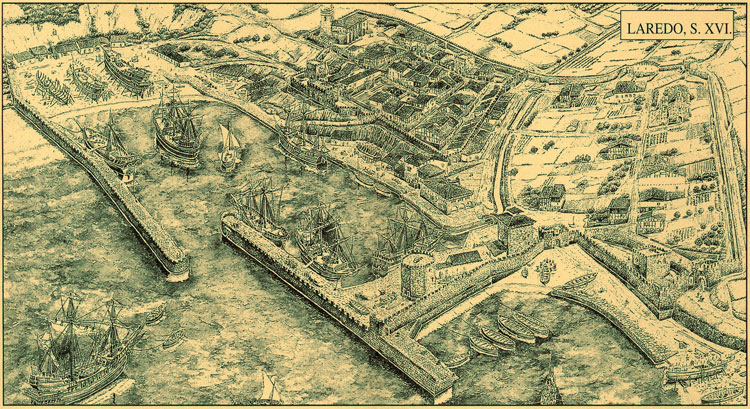
Before delving into this place brimming with art, history and spirituality, we will tell you a bit of history. Laredo’s origins go back to the times of Roman rule, but it was not until 1200 when the town gained relevance thanks to the jurisdiction granted by King Alfonso VIII. Laredo became a relevant fishing and commercial port that traded all kinds of merchandise with northern Europe. It was also a mooring place for the Castilian royal and military fleets. It is necessary to highlight the relevant royal visits, such as that of Queen Isabella I of Castile in 1496 accompanying his daughter Joanna who was leaving for Flanders to marry Philip the Handsome. During this visit, she met with the Cantabrian cartographer Juan de la Cosa and gave an organ to this church of Assumption of Mary. In 1501 Catherine of Aragon embarked to marry the Prince of Wales. Years later, in 1556, the emperor Charles V arrived at our port on the way to his last retirement in the Yuste monastery. He stayed a week in our village and went daily to the services in this temple. In 1559, his son Philip II disembarked upon returning from his successful military campaigns in Saint Quentin and Gravelines.
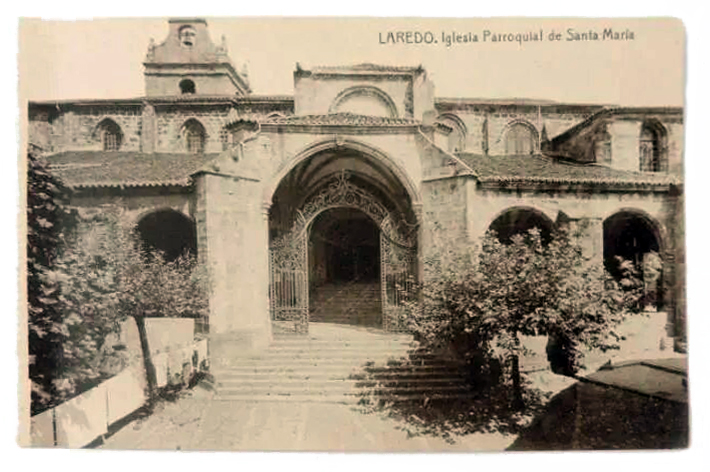
After these historical data that show the past importance of the port and town of Laredo, and before entering the temple, contemplate the main façade located on the southern wall. Its construction began at the end of the 13th century and consists of a pointed arch. This arch has three magnificent archivolts that were once polychrome. The outermost archivolt is dedicated to the Apostles and saints. In it, Saint George can be distinguished with a sword and chain mail. Maidens can also be seen carrying containers that could represent the wise virgins of the Gospel. The intermediate archivolt shows sculptures of angels and the Apostle Saint James is identified with his classic pilgrim clothing.
Now you can cross the threshold and access the parish church of Assumption of Mary, one of the most representative temples of the Gothic style on the coast. The building is erected in the highest part of the town. The construction of the temple that you now visit began in the first third of the 13th century, on the remains of the hermitage of the Virgin of Bethlehem. The initial plan had three naves without a crossing, but due to the economic boom, the original plan was modified to make the temple more monumental. This change consisted of adding a new major nave, identical to that of Bethlehem, already half-built, and which currently houses the main altar. With this change, the church has four naves. From the 16th century, different architectural elements were added, such as Escalante’s Chapel, the chapels on the north wall, the bell tower and the current portico.
“All of you surely know that you are God’s temple and that his Spirit lives in you”
1 Corinthians 3, 16
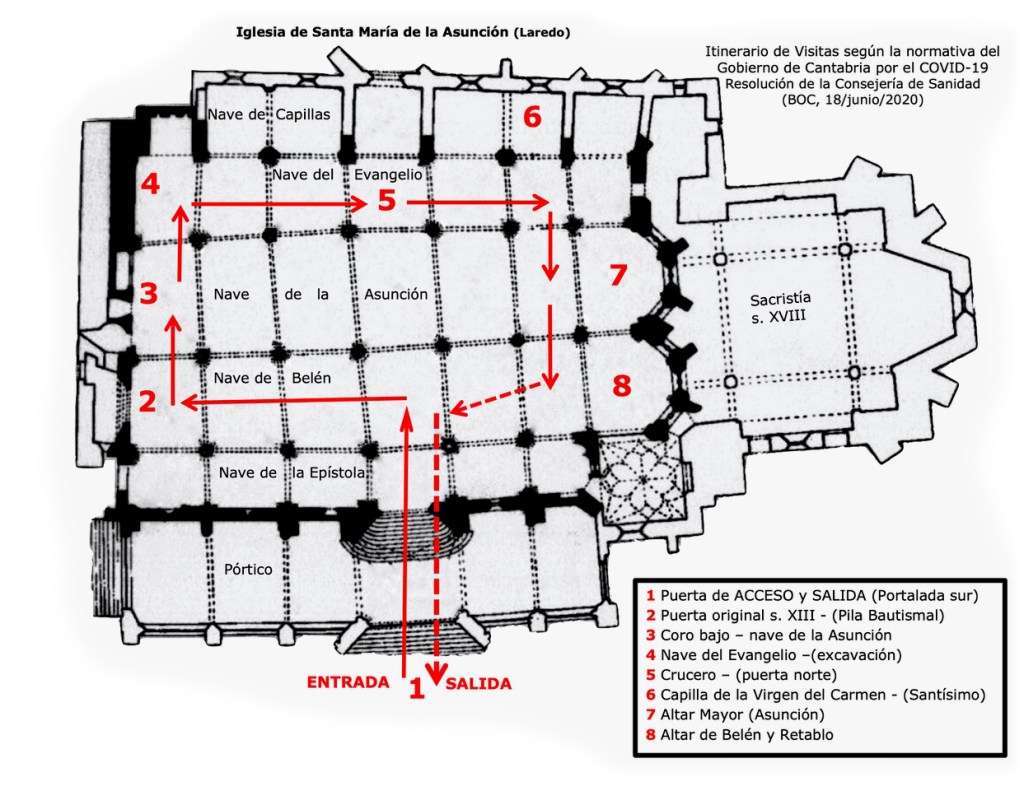
PLAN OF VISIT AND ROUTE
1. Access and exit door.
You are in the south nave, the oldest in the temple. In it you can recognize architectural features of proto-gothic aesthetics. To the right of the door through which you entered, contemplate the imposing carving of the Christ of Forgiveness that takes part in a procession of Holy Week in Laredo. In the Catholic world, veneration of «Crucified Christ» is very common. The faithful people have always known that the Christian proclamation is anchored on a cross. In it Jesus redeemed us, freed us from sin and death by giving his life for us. The Cross is not understood as a defeat, but as the prelude to the definitive triumph over death that will come with the Resurrection.
2. Original door (13th century)
Go to the back of the temple. In the background you can distinguish the stained glass window of La Pietà, with striking bluish tones. Blue is the colour of Mary, a symbol of holiness, harmony and royalty. Maria holds in her lap the inert body of her son, suffering for his Passion and Death. To its right, in the nave of Bethlehem, there is a pointed arch cover that was the original main entrance and where the baptismal font is located. Baptism is the foundation of the Christian life. It is the portico of life in the Spirit and the door that opens access to the other sacraments. By the Baptism we are freed from sin and regenerated as Sons of God, incorporated into His Church to be members of Christ. At the top of this baptismal chapel you can see a magnificent painting of the “Baptism of Jesus”.
“I tell you for certain that before you can get into God’s kingdom, you must be born not only by water, but by the Spirit”
Saint John 3, 5
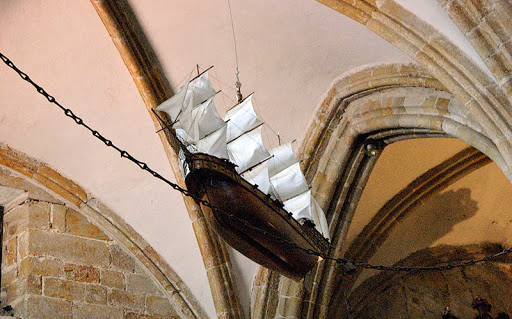
Before continuing the visit, raise your gaze to the vault of the Bethlehem nave. In it, parts of the chains that held the boats of the Triana Bridge hang, awarded by Ferdinand III the Saint as a trophy and a reminder of the important participation of the people of Laredo in the Siege of Seville in 1248. On them, a votive ship, from a later period, that shows the seafaring tradition and the devotion of Laredo. Sailor votive offerings were too frequent to thank for the favours granted. Some of them are preserved as a memory of past times.
3. Under Chorus. Nave of the Assumption.
Passing next to the choir and under the majestic German organ of the 20th century, the visit continues to the nave of the Gospel.
4. Nave of the Gospel. Excavation.
In its first chapel is the classicist altarpiece of Our Lady of Sorrows or Virgin of Solitude. Mary occupies the central niche as a young mother, with fine features and great serenity. This beautiful carving was made in 1954 on behalf of the Brotherhood of Holy True Cross and the Virgin of Solitude. It is an image whose delicate face reflects the contained pain of a mother for the loss of her child. It is said that the artist was inspired by two young women from the town to make the face and hands of this beautiful image of great veneration among the inhabitants. His contemplation does not leave you indifferent. This image is accompanied by Pope Saint Gregory the Great and the Apostle Saint John, who carries a chalice with the serpent and the eagle at his feet.
5. Crossing and North gate.
6. Chapel of Our Lady of Mount Carmel.
It is a chapel, above all, for prayer and silence. In a world full of “noises”, this is a place for the encounter with the God incarnate in Jesus Christ who in this tabernacle is “really and truly present in the consecrated bread”.
This space is dedicated to the Virgin of the Mount Carmel, patron saint of fishermen and sailors, who is invoked to protect them from shipwrecks and storms at sea. On the sides of the main sculpture, you can distinguish the carvings of the co-patrons of Laredo, Saint Lawrence with the grill, symbol of his martyrdom, and Saint Roch that shows the sores on his leg and is accompanied by a dog that would help him at times of need. This animal is a sign of providence and is always included in the saint’s iconography. The ensemble is topped by an unusual Holy Trinity. It is a striking sculptural group where the three divine people appear with the same appearance. Although this interpretation of the Trinity was frequent in the Gothic period, it was condemned at the Council of Trent and in 1628 Urban VIII formally prohibited the subject, described as heretical. In addition, he ordered the images of this type to be burned, which explains their small number.
In the lower part of this altarpiece, the Eucharistic Presence of the Lord in the Tabernacle the greatest treasure we can find in this temple seems to go unnoticed. The living Christ has saved and redeemed us, has freely given us eternal life and is always at our side.
“Our salvation is a gift of the blood of Christ. Everything is a free gift from God and his love for us”
In this chapel is the Virgin of the Nets, a seated alabaster carving without the Child, which has had a great popular devotion for centuries. On the opposite wall to the altarpiece is the suggestive relief “Easter of the Ascension” where the eleven apostles are on the sides of the Virgin and Jesus is ascending over them. Next, there is the Chapel of the Nativity with five 17th century paintings from the Murillo school; the Annunciation, the Visitation, the Birth of Jesus, Jesus child with Saint John and the Holy Family.
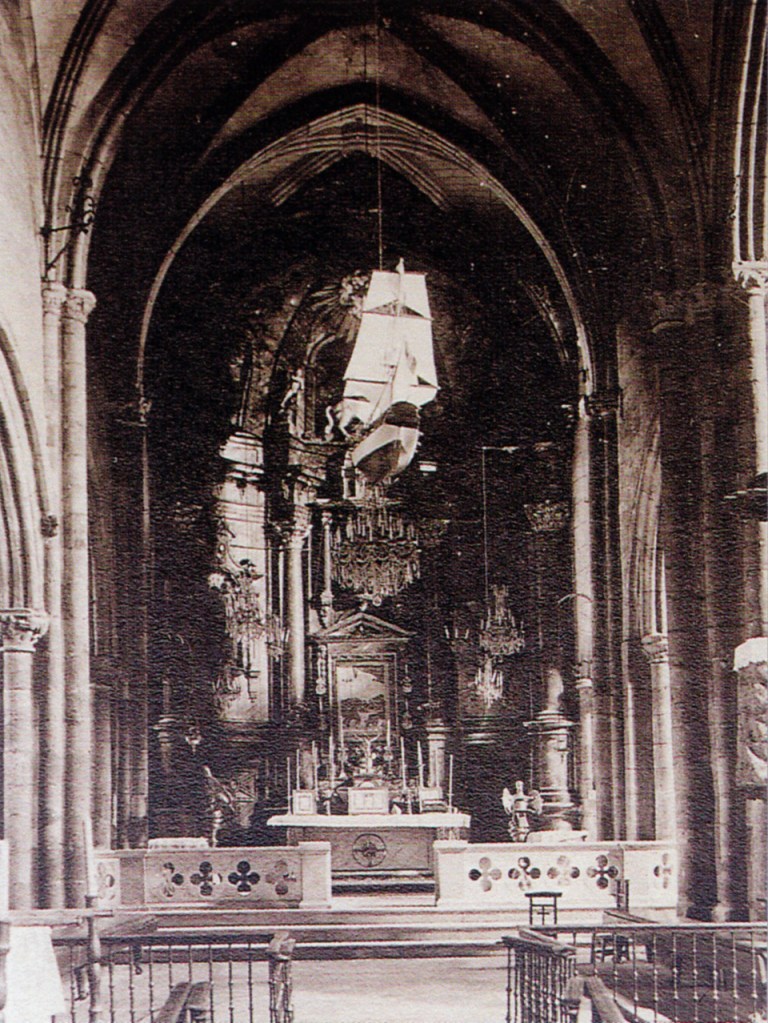
7. Main Altar.
You arrive at the main altar located at the head of the church which, as usual in Christian temples, faces east, because from the east rises the sun that is a symbol of Christ and that, like Christ, illuminates us and gives us life. Light enters through the three large openings of the apse. Light, understood as a symbol of divinity, is a fundamental element of Gothic architecture. The ensemble is presided over by a sober crucified Christ and by the image of Our Lady of the Assumption, patron saint of the town of Laredo, to whose dedication the temple is dedicated. It represents the moment in which the Virgin Mary, at the end of her earthly life, is taken to Heaven in body and soul by various angels who lift her to heavenly Glory. Both spiritually and artistically, it must be framed within a general phenomenon, after the Reformation, of extolling the cult of the Mother of God.
Two striking golden choir lecterns whose lecterns are two eagles guard the altar. They were a gift from Emperor Charles V during his stay in the town in 1556.
“The altarpiece is the most beautiful work of polychrome sculpture in Flemish art in Cantabria and one of the most amazing and complete sets of this style that exists in Europe”
8. Altar and Altarpiece of Bethlehem.
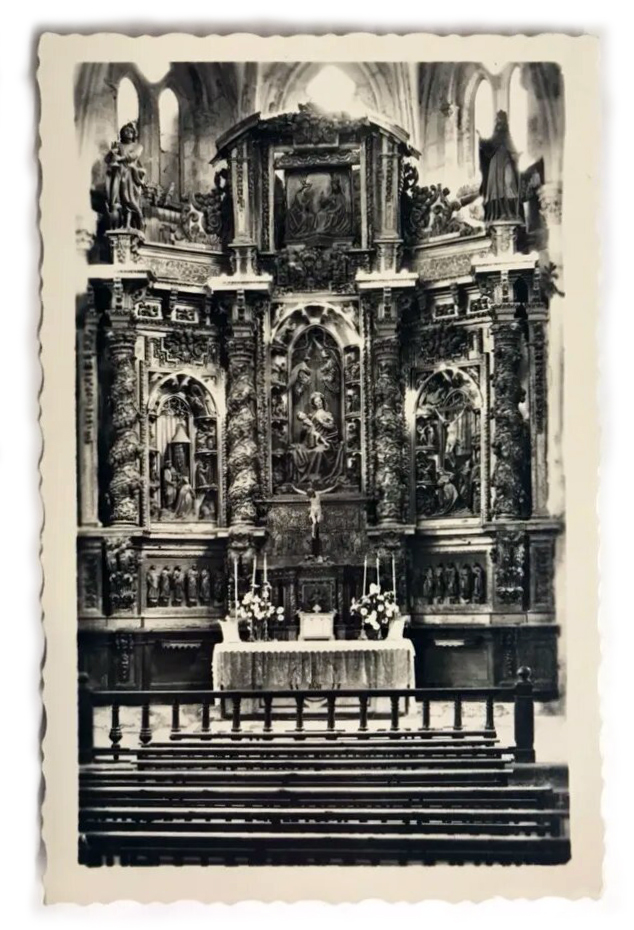
Now it is time to contemplate the extraordinary altarpiece of the Virgin of Bethlehem. It is one of the most important works of European sculpture and the jewel of this temple. This Flemish work from the end of the 15th century was probably made in Brussels, whose author was inspired by the paintings of Roger van der Weyden. Originally it would have a triptych shape, but currently the sculptural group is framed by a baroque structure from the late 17th century. It consists of a body, bench, topped by an attic and divided into three streets separated by sumptuous Solomonic columns.
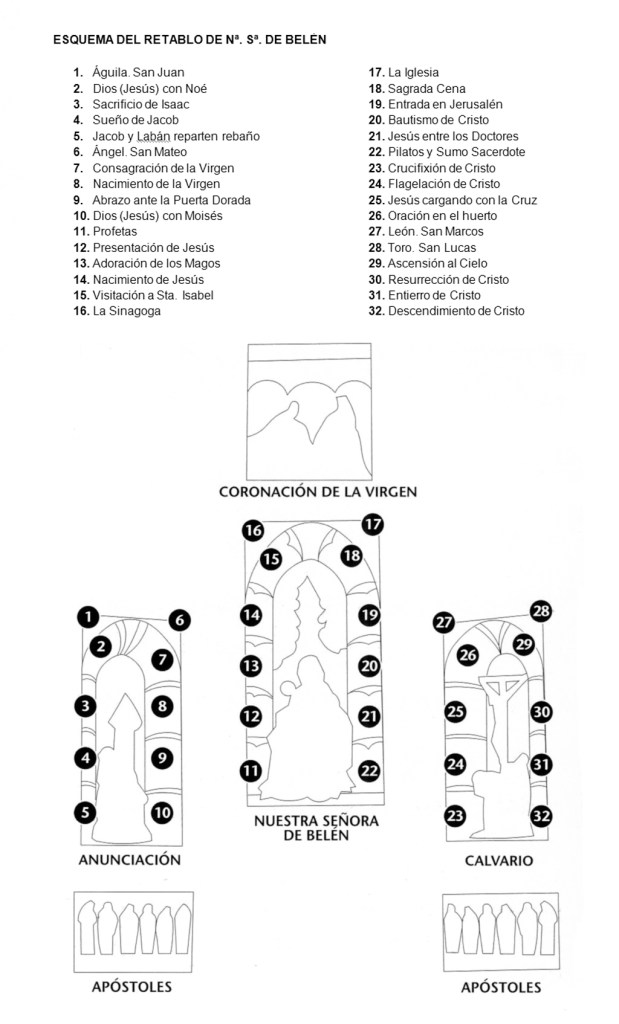
Each of its streets is formed by a niche with double pointed arches. The central image is the Virgin of Bethlehem, surrounded by the Christmas cycle and the public life of Jesus. The Virgin of Bethlehem belongs to the so-called group of the Galaktotrofusas, “Virgins who are shown feeding their son”, a sign of Mary’s humility. For its part, the Child’s smile is a sign of the full incarnation of the Son of God, reinforced in her need to be fed like any newborn.
On her right, the whole of the Annunciation with eight scenes related to the biblical promise of the arrival of the Messiah and to the childhood of the Virgin. In the foreground the Virgin kneeling, with the angel Gabriel behind, is in an attitude of greeting. It is the moment in which the Redemption begins.
To its left, on the Epistle side, there is an extraordinary Calvary. It is a magnificent representation of Christ, with a realistic body and a dramatic expression. The suffering presence of the Virgin and Saint John at the foot of the Cross enriches the complex, surrounded by eight reliefs with the Passion and Death of Our Lord. Calvary is the culmination of the mystery of the Redemption. At the bottom you can see the twelve Apostles, while the ensemble is topped by a majestic relief of the Coronation of the Virgin. Christ crowns his Mother as Queen of heaven.

“I am the Lord’s servant! Let it happen as you have said”
Luke 1, 38
There is not much more to explain, but to contemplate and delight in this beautiful ensemble that extols the figure of Mary. Thanks to her “Let there be” (FIAT), the promise is united with redemption and salvation. It is undoubtedly the most beautiful moment in all of human history. It is a unique and unrepeatable event, the moment in which God waits for the Yes of a human being to be able to come to the world in flesh and blood, to save us. It is the moment in which Mary gives herself completely to God to participate in human Salvation, being the mother of God and the new mother of all people.
It should be noted that behind the Plateresque grille on the right, there is the Chapel of the Conception or “Escalante’s” from 1537. It was a renowned Laredo family who, possibly, acquired the triptych on one of their trips to Flanders.
“God loved the people of this world so much that he gave his only Son, so that everyone who has faith in him will have eternal life and never really die”
Saint John 3, 16
The visit where we have combined art and faith finishes. We wish it was pleasant. Before leaving the temple to continue your journey, we invite you to have a moment of recollection and prayer, to sit silently before the presence of the Virgin Mary meditating on her life of surrender and gratitude, or simply, praise and give Glory to the Lord in front of the Tabernacle. To do this, we put at your disposal some prayers that can be useful at this moment.
Gospel of the day. EVANGELIZO / IBREVIARY
ROSARY / VIA CRUCIS / VIA LUCIS
Prayers for the Way of Saint James / Diocese of Santander
MASSES
Sundays and holidays: 12pm.
HELP US
«For now there are faith, hope, and love. But of these three, the greatest is LOVE.» (1 Cor. 13, 13)
If you can much; much. If you can little; a little bit. If you can’t do anything; nothing.
WHEN YOU LEAVE THE CHURCH, MAKE YOUR DONATION. GOD BLESS YOU.
* * * * * * *
PRAYER TO OUR LADY OF ASSUMPTION
Mary, Queen assumed into heaven, I rejoice that after years of heroic martyrdom on earth, you have at last been taken to the throne prepared for you in heaven by the Holy Trinity.
Lift my heart with you in the glory of your Assumption above the dreadful touch of sin and impurity. Teach me how small earth becomes when viewed from heaven. Make me realize that death is the triumphant gate through which I shall pass to your Son, and that someday my body shall rejoin my soul in the unending bliss of heaven.
From this earth, over which I tread as a pilgrim, I look to you for help. I ask for this favour: (Mention your request).
When my hour of death has come, lead me safely to the presence of Jesus to enjoy the vision of my God for all eternity together with you. Amen.
PRAYER TO OUR LADY OF MOUNT CARMEL
O beautiful Flower of Carmel, most fruitful Vine,
Splendour of Heaven, holy and singular, who
brought forth the Son of God, still ever remaining
a Pure Virgin, assist me in this necessity.
O Star of the Sea, help and protect me!
Show me that thou art my Mother.
O Mary, Conceived without sin,
Pray for us who have recourse to thee! Mother and Ornament of Carmel, Pray for us!
Virgin, Flower of Carmel, Pray for us!
Patroness of all who wear the Scapular, Pray for us!
Hope of all who die wearing the Scapular, Pray for us!
St. Joseph, Friend of the Sacred Heart, Pray for us!
St. Joseph, Chaste Spouse of Mary, Pray for us!
St. Joseph, Our Patron, Pray for us!
O sweet Heart of Mary, be my Salvation!
PRAYER TO THE VIRGIN OF THE NETS OF LAREDO
The sailors paint it just like their ships, despite being made of marble.
Because it's not her, bloated in her niche, but to "Maris Stella" red,
to "Jesus and inside" blue,
to "If you want to tell me" also red,
to "Regina" redder,
to "Starfish" green,
to those who protect from water, sun and wind.
Amen.
 Iglesias de Cantabria